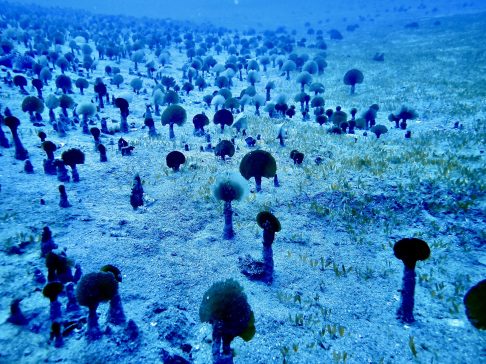
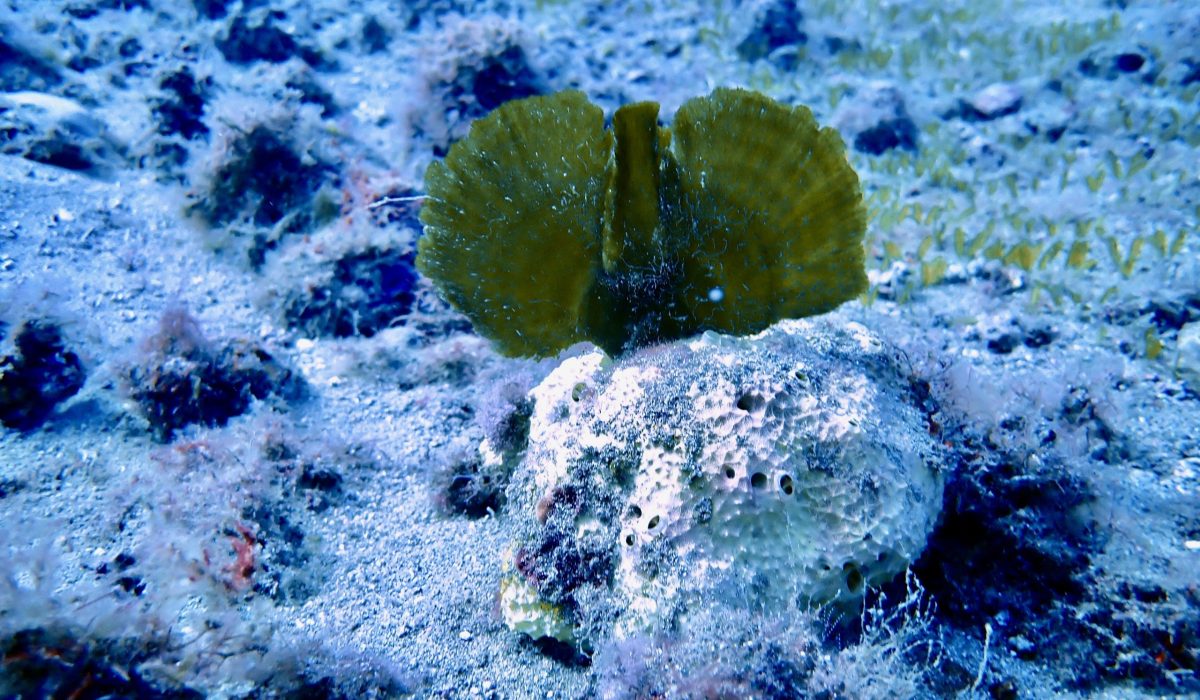
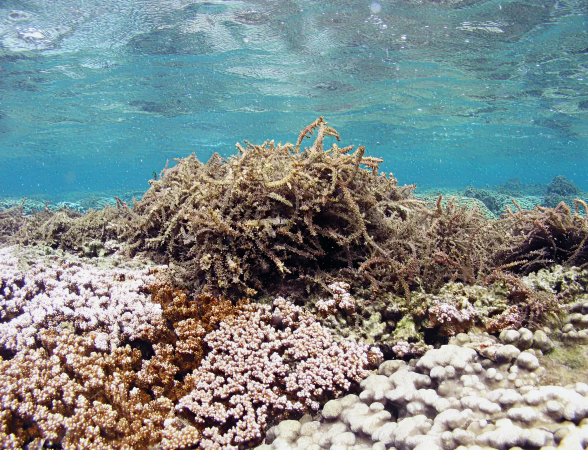
A green seaweed that grows in mats and can take over native plants and animals.
Leather Mudweed (Avrainvillea lacerata)
Fan shaped blades attached to single stalk 2
Blades are green in color, usually covered with sand and appear brown 2
Formally known as Avrainvillea amadelpha in Hawaiʻi
Habitat
Found attached to coral, rocks, or in flat sandy areas with low water motion 2
Impacts & Concern
High tolerance to environmental extremes 3
Can change community diversity of reefs, lowering fish and invertebrate populations 3
Creates mud layer on top of sand which changes nature of habitat 1
Outcompetes native algae, corals, and seagrasses 1
Introduction
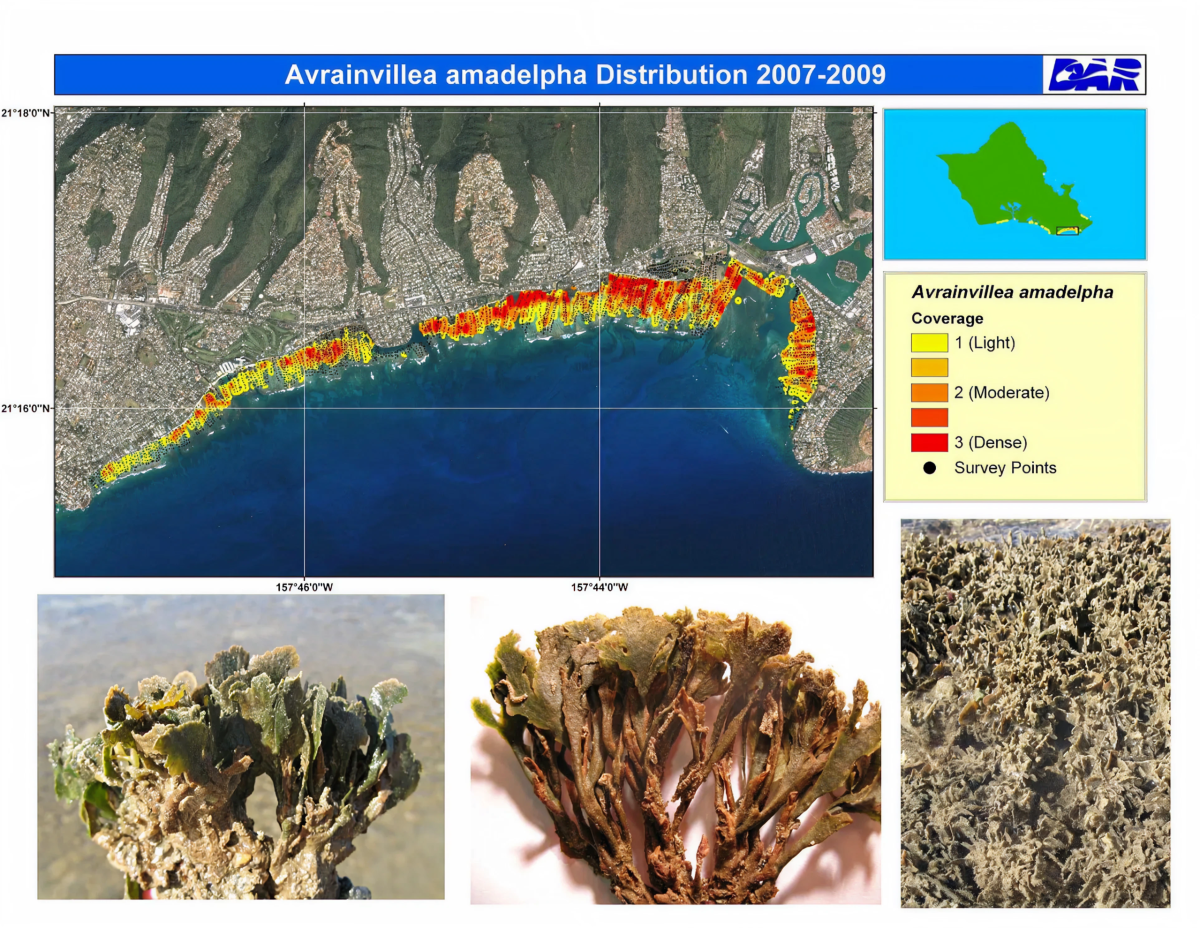
First discovered in Hawaiʻi in 1981 3
Mechanism of introduction is unknown 1
Unknowns
Shows low potential to reproduce via small fragmentation, however is highly invasive which raises questions about if fragmentation is the primary form of reproduction 4
Distribution in Hawai‘i
Kauaʻi: Present
Oʻahu: Present in Diamond Head, Waikīkī, Koko Head, Kahe Point
3. Veazey, L., Williams, O., & Wade, R. (2019). Present-Day distribution and potential spread of the Invasive Green Alga Avrainvillea amadelpha around the Main Hawaiian Islands. Front. Mar. Sci., 6. https://doi.org/10.3389/fmars.2019.00402
4. Albright, S. (2017). A Growing Problem: The Missing Link for Ecological Success by the Invasive Avrainvillea. [Bachelorʻs Honors Project, University of Hawaiʻi Mānoa]. https://core.ac.uk/download/pdf/211323725.pdf