2/6/24 – 20 Years of the Barbless Circle Hook Project

In 2004 Kirk Kawamoto, the fishing liaison extension agent at NOAA Pacific Islands Fisheries Science Center (PIFSC), and Earl Miyamoto, the head of the Division of Aquatic Resources (DAR) Protected Species Program (PSP), came together to find a solution to the increasing amount of Hawaiian monk seals and sea turtles getting hooked. The hooks that were causing the most life threatening injuries to these animals were barbed circle hooks, as well as the fishing line. Seals often get unintentionally hooked when they get a little too interested in a fisherman’s catch or eat the bait. Sea turtles are like the cows of the sea, and while they are grazing along for limu they can get caught up in hooks and fishing line that gets left behind on the reef, and occasionally like to eat the bait as well. While the fishing line is the most dangerous part to these seals and turtles, the barbed hooks can also cause severe damage if swallowed, and often result in the animal needing surgery. The barb on the hooks also makes it extremely challenging for responders to remove the hooks from these already unhappy animals’ jaws. Kirk and Earl started the Barbless Circle Hook (BCH) Project to raise awareness of this issue and to offer solutions to fishers who shared their concern for aquatic life.

A seal and turtle entangled in fishing gear
The impacts that shoreline fishing can have on marine species. (Photo credits NOAA fisheries and Mimi Olry)

When the project started in 2004 they had zero funding, but they first began by testing the feasibility of using barbless circle hooks. They tried to answer all the questions fishermen would have before they asked. Bert Kikkawa ran a research project involving the Kewalo Keiki Fishing Conservancy, the Pacific Islands Fisheries Group, and interested fishermen. This study compared barbed vs barbless catch from the shoreline. The study showed that there was no statistical differences in the catches, misses, or losses between the hooks, which was great news, the hooks work! Unfortunately, the formal publication is still unfinished as Bert Kikkawa passed away before completion, but the team produced a poster outlining the results.

A poster summarizing a study on fishing with barbless hooks
The study comparing barbed vs barbless catch from the shoreline.

Their next steps were to increase the awareness and use of BCHs by Hawaii’s shoreline fishermen, specifically on O‘ahu. They started off by using the BCHs in their own fishing practices, talking story with fishermen, going to fishing stores and tournaments promoting  “going barbless”. The use of barbless circle hooks are not just for ulua, but also for whipping, casting, dunking, slide bait, any kind of pole fishing.

Main reason to fish barbless 

  1. It’s better for the fish. It’s easier to quickly release unwanted catch without causing damage to the fish, which means more and healthier fish for you to catch in the future.
  2. It’s better for you. Minimize injury to yourself and others, as well as damage to shirt, shorts, and nets.
  3. It’s better for Hawaii’s protected species. Barbless hooks reduce potential injury in the event of an accidental hooking or entanglement, and allow for quicker release or self-shedding release to reduce trauma and enable a return to normal activities.
  4. They do work! In 2005 their first major success was when one their teammates, Mitchell Taketa, caught the first ulua using a BCH. Then in 2006 there was major growth for the project with the first two tournaments featuring a barbless category and the first all-barbless tournament. There was also the first over 100 pound ulua caught using barbless hooks when Randall Elarco Jr. reeled in a 117 pounder which is still the record for barbless. That year Randall was given a special 100 Pounder award at the Fishing and Seafood Festival in Honolulu by Honolulu Mayor Mufi Hanneman for his historic catch and an additional special award was given to Mitchell for catching the first barbless circle hook ulua for the project. 

In 2007 the barbless self-shedding concept was proven by NOAA staff and volunteers on Hawaii Island. There was a hooked seal that responders were trying to de-hook when the seal threw the BCH from its mouth on its own in front of them! This was pivotal in helping to convince fishermen and researchers of the potential of BCH. 

Winners of fishing tournaments holding their catch
Randall Elarco Jr. record breaking ulua catch and the Tokunaga ulua challenge 2006 vs. 2023. (Photo credits Barbless Circle Hook Project)

In 2008 the amount of tournaments continued to grow, with fishing barbless as a category for 7 tournaments. The popularity of using BCH has continued to increase and it is now a statewide initiative. In 2023 the barbless team continued to promote “going barbless” at 14 fishing tournaments, and at fishing stores in across Hawaii doing pop-ups to give out free hooks, swag, and information. This work will continue on into 2024. 

If you would like to try out some barbless hooks for free- message us on our socials:

BCH Instagram & Facebook: @barblesscirclehookproject

Sign up for the newsletter: Click here

Check out these videos the barbless team has recently produced:
Fishing with Barbless Hooks, Part 1

Fishing with Barbless Hooks, Part 2

If you are out fishing and you do accidentally hook a monk seal or a sea turtle please report the event to Hawaii’s Marine Animal Response Hotline: 1-888-256-9840

Please visit our website to learn more about fishing around protected species. 

1/22/24 – Non-native corals removed from Anini lagoon on Kauai

In the summer of 2021, Robin Mazor and Tom Woods with the non-profit organization Reef Guardians Hawaiʻi contacted the Division of Aquatic Resources (DAR) to let them know that while snorkeling in the lagoon at ʻAnini (Wanini) beach on Kauaʻi, they saw some corals that were unfamiliar to them and appeared to have been placed onto the reef. DAR looked at their photos and confirmed that the corals were not native corals found in Hawaii. The DAR Aquatic Invasive Species (AIS) team came out and removed the colonies from the reef. During removal, some of the corals were found to have zip ties in what appeared to be an attempt at attaching the corals to the reef. Others were found with coral “plugs” that are used in other parts of the world to grow and outplant coral. Several different species were found, all of them are commonly used in saltwater aquariums. It became clear that someone had intentionally placed these non-native corals in the reef.

Image collage of divers collecting non-native corals and of two people smiling and waving.
DAR team collects non-native coral from ʻAnini reef. Tom Woods and Robin Mazor of the Reef Guardians who originally reported the non-native coral.

Perhaps this person was well-meaning, but there are several problems presented by non-native corals in Hawaiian reefs. The first is that importing non-native corals to Hawaiʻi is against the law. Some people will bring them to Hawaiʻi to put in their aquarium tanks because they think they look pretty, but the Hawaiʻi Department of Agriculture restricts the importing of corals and many other animals that could be harmful to the ecosystem if they escaped. Another problem is that putting these corals on the reef in Hawaiʻi may lead to new diseases being brought into the area. Fish or invertebrates that feed on coral may also be exposed to disease if the coral carries unknown pathogens. Furthermore, if the coral survives in this new environment, it poses another problem by competing with native coral species in the ecosystem. There is a delicate balance in coral reefs, and when other species are introduced that don’t belong there, they can upset that balance and possibly over-take the native species.

A collage of aquarium corals found at Anini beach
Some of the non-native coral species found on the reef at ʻAnini.

Since the first sighting in 2021, Reef Guardians has continued to monitor and report findings of non-native coral at ʻAnini, most recently in November of 2023 when a colony of leather coral was found and removed. DAR believes these are still the remnants of the first out-planting of non-native coral, especially since they have been found in the same general area. Each time they were reported, DAR has responded and removed the non-native coral, but it shows how important it is that the community keeps an eye out for things that don’t look right on the reefs. DAR depends on the amazing help from Reef Guardians and other keen observers to be made aware when issues arise in the aquatic environment.

You can help keep invasive species off our reefs by reporting potential sightings to DAR’s Aquatic Invasive Species team. Send a picture, description, and as precise of a location as possible to [email protected]. Click here to read a blog post about DAR’s rapid response to potential new invasions.  

If you have an aquarium and need to dispose of your fish or other aquatic life, please do not release them in the ocean or streams. Even if you have native animals in your aquarium, you could introduce disease into the environment. The proper way to dispose of legal aquatic life is to either humanely euthanize them or reach out to other aquarium owners or pet stores who may be happy to take your animals. The Hawaii Department of Agriculture has an amnesty program that allows anyone to turn in illegal animals without penalty. See https://hdoa.hawaii.gov/pi/pq/amnesty-program-2/ for more information. If you have coral, regardless of whether it is native or not, it is illegal to sell it or cultivate it without a permit (HAR 13-95-70, HRS 187A-6); contact your local DAR office for guidance.

For further reading, see the following pages:

Hawaii coral and live rock rules.

FAQ for coral cultivation and restoration activities

DAR coral nursery and restoration program

DAR coral nursery Instagram page

If you see illegal activity, you can report it to the Division of Conservation and Resource Enforcement at (DOCARE) at 1-855-DLNR-TIP (1-855-356-7847), or the Fish and Wildlife Service Tip line 1-844-FWS-TIPS (1-844-397-8477). You can also contact your local DAR office for any questions or concerns.

12/5/23 – Rapid Responses to Introduced Species by the Aquatic Invasive Species Team

By Trevor Johannsen, Fishery Technician IV

The Hawaiʻi Division of Aquatic Resources (DAR) Aquatic Invasive Species (AIS) Team manages and prevents AIS in Hawaiʻi. One important responsibility of the AIS Team is to rapidly respond to non-native species introductions. When a species is first introduced, there is a short window of time in which it can be completely eradicated. Once an introduced species becomes established and widespread, eradication is often nearly impossible. Introduced species may be considered invasive when populations expand to the point of causing harm to native ecosystems, human well-being, or the economy and it is difficult to predict which introduced species have the potential to become invasive and which do not. Because of this, it is critical to treat all newly introduced species as a priority and to rapidly respond with an investigation and removal if possible.

In the past few months, the AIS Team has responded to several reports of newly introduced species and possible vectors of AIS spread. For each of these rapid response events, public support was crucial in reporting initial observations. The Division of Aquatic Resources encourages the public to report possible new AIS introductions to [email protected]. Please include photos and GPS coordinates when possible. DAR also encourages the public to use the crowdsourcing website www.inaturalist.org to track observations. With millions of residents and tourists enjoying reefs and oceans in Hawaiʻi every year, the potential for discovering an early outbreak of AIS can be increased. With continued public support, we can detect and respond to reports earlier and have a better chance of eradicating introduced species in Hawaiʻi.  

Manatee Mudflower
On July 6, 2023, the AIS Team received a report of a new aquatic plant introduction. The report was filed by Kevin Faccenda, a graduate student in the University of Hawaiʻi at Mānoa Botany Program. The species was confirmed as manatee mudflower (Micranthemum glomeratum), a freshwater aquatic plant native to Florida. It is unknown how this plant was introduced into the stream. However, manatee mudflower is a common freshwater plant in the aquarium trade, so it is probable that this introduction resulted from an aquarium dump.  Aquarium release is a common vector for the introduction of new species to Hawaiʻi. The AIS Team performed an initial investigation on July 26, 2023, and a more thorough survey downstream on September 5, 2023. During the surveys, the AIS Team discovered that manatee mudflower has spread from the initial point of observation to include several small patches about 200m downstream. Charles Chimera conducted a Weed Risk Assessment of M. glomeratum and concluded that this species poses a high risk of invasion because it can spread both vegetatively and by seed. Going forward, the AIS Team will be conducting delimiting surveys to determine the extent of the spread of manatee mudflower.

Low growing plant covering a rock by a stream
Manatee mudflower growing on a rock in Nuʻuanu Stream

Marine Debris
On September 27, 2023, The AIS Team responded to a report of marine debris that washed ashore near Kualoa Ranch on Oʻahu. The debris was identified as the refrigeration component of a shipping container that had undergone heavy biofouling the gradual accumulation and growth of aquatic organisms on the undersides of vessels or other floating objects. Most of the unattached organisms caught on the debris were common native algae or invasive algae already found in Hawaiʻi. The AIS Team collected samples of any suspected non-native or unknown organisms to give to Holly Bolick at the Bishop Museum for analysis. However, no immediate concerns were visually identified. The Hawaiʻi Division of Boating and Ocean Recreation removed the debris from the shoreline on the same day of the initial response. Floating marine debris is another common vector for introducing new species to the islands. It would have been a major concern if the AIS Team had found any unreported species.

Junk washed up on a beach
Marine debris washed ashore near Kualoa Ranch

Caulerpa parvifolia
A newly introduced species of algae was recently discovered on Kauaʻi. In 2020, DAR received reports of unknown algae washing up on Kalapaki Beach and covering parts of the reef in Nawiliwili Bay. Genetic analysis determined the species to be Caulerpa parvifolia, another common species in the aquarium trade. Unfortunately, it was already infeasible to attempt any eradication at the time of discovery because the algae had become firmly established and widespread across the Bay. Follow-up surveys in the summer of 2021 showed a substantial thinning of the algae. However, additional surveys in the winter of 2022 found a resurgence with large mats in the Bay. In August 2023, the AIS Team assisted the DAR Kauai Team in surveying the easternmost part of Nawiliwili Bay which had not been previously surveyed. Caulerpa parvifolia was found to be present in low concentrations. To date, C. parvifolia has not been found outside of Nawiliwili Bay.

Thick mat of algae growing on a reef
Caulerpa parvifolia growing in Nawiliwili Bay, Kauaʻi, in 2022

11/16/23 – Coral Reef Monitoring in East Hawaiʻi

Devon Aguiar, HCRI East Hawaiʻi Habitat and Fish Monitoring Specialist


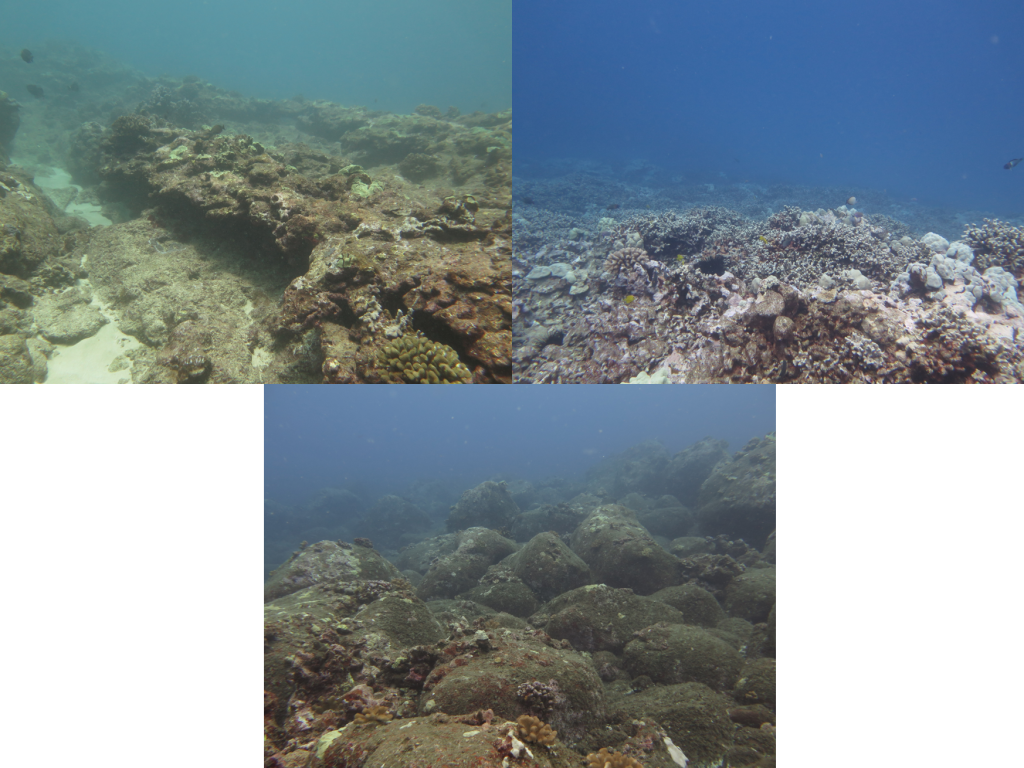
Starting in December 2022, DAR began conducting coral reef monitoring surveys throughout the East coast of Hawaiʻi Island. Because this region has not been a major focal point for coral reef research, little is known about reefs in East Hawaiʻi. Using SCUBA survey methods employed by DAR teams on other islands, we can collect paired fish and benthic (bottom habitat) data from each survey. This paired approach allows us to directly link fish observations to different habitat types.


Different types of reef habitats observed in East Hawaiʻi


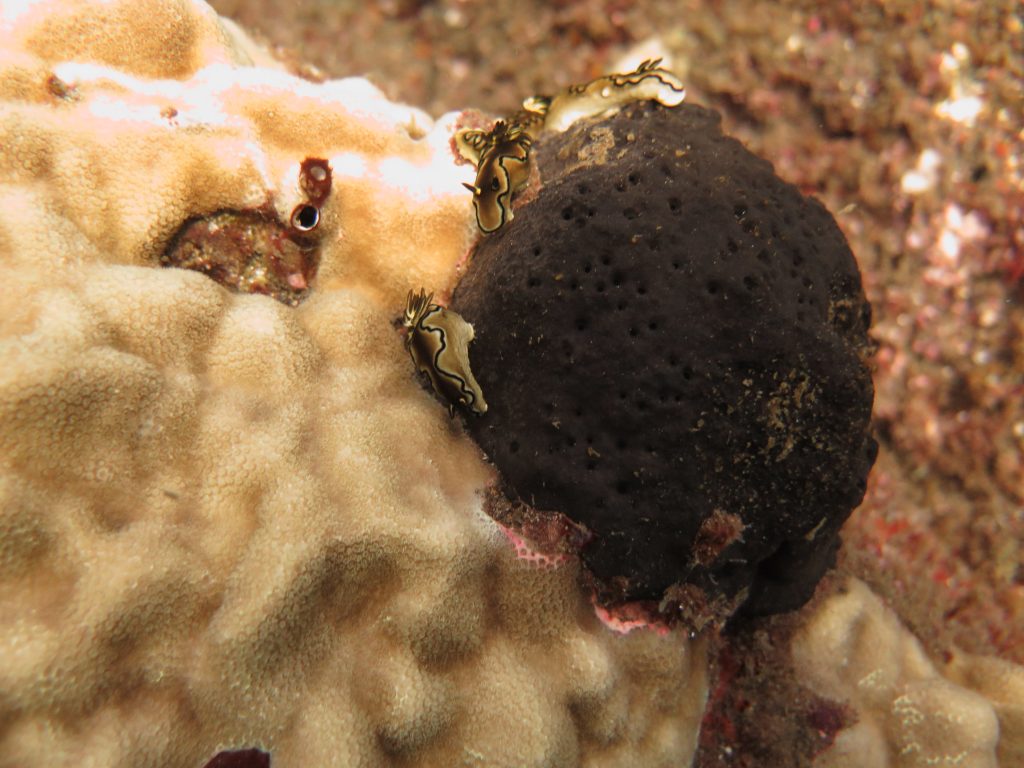
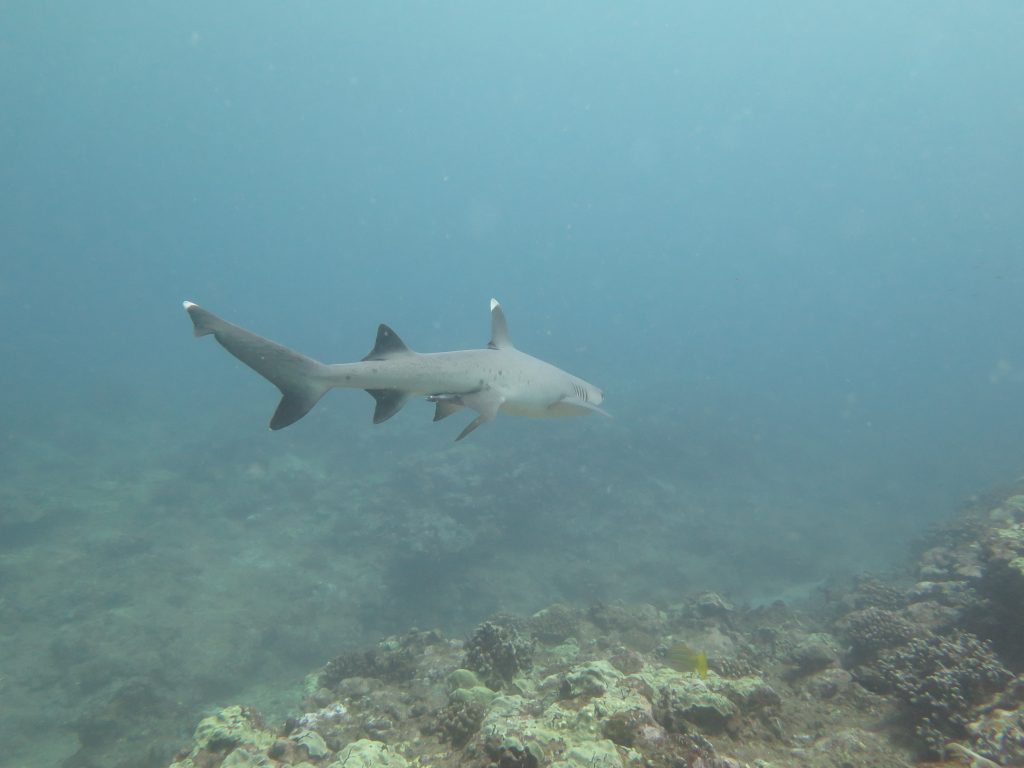
To date we have conducted 74 surveys throughout Keaukaha, Blonde reef, and the Hilo Palikū coastline. Each of these sites have unique physical features that reflect the environment, such as spur and groove formations on reefs exposed to waves. These formations are characterized by long ridges of coral separated by deep sand channels. In addition to the physical aspects, we have also gained insight into the organisms living on these reefs. We have observed unique invertebrates such as the endemic coral Porites hawaiiensis, the oceanic sponge (Spongia oceania), and several nudibranch species. We have also documented a variety of fish species at these sites, some of which are less common in other parts of the Main Hawaiian Islands. During surveys we’ve come across schools of large adult and juvenile kole (Ctenochaetus strigosis), some knifejaws (Oplegnatus punctatus), and even a curious white tip shark (Triaenodon obesus).


Black margin nudibranchs feeding on an oceanic sponge
shark swimming over a coral reef
A white tip shark stops by during a survey


With the goal of monitoring and tracking changes on the reef, we plan to continue our surveys next year we aim to continue these surveys long-term. In addition to re-visiting some areas, we also plan to survey additional portions of the coastline to gain a broader perspective of the marine environments in East Hawai‘i. We also plan to integrate novel more advanced and modern techniques such as Structure from Motion photogrammetry to better understand the complexity of reef structures at each site.


This work is funded by the National Oceanic and Atmospheric Administration Coral Reef Conservation Program award number NA21NOS4820017.

11/2/23 – Protected Species Spotlight: Manta Rays

By: Devon Stapleton
DAR Protected Species Program

Meet the Species
Have you ever seen an oceanic manta ray? The oceanic manta ray, or Mobula birostris, is the largest ray species in the world. According to NOAA, this gentle giant has a wingspan reaching up to 26 ft and weighing over 5,300 pounds! Oceanic mantas are known to live over 45 years, based off of photo-identification records. Manta rays give birth to a single live pup, and when they are born they must immediately fend and forage for themselves.

A scuba diver with a manta ray
Photo by Dr. Andrea Marshall, Marine Megafauna Foundation

Behaviors
Oceanic mantas are usually found further offshore compared to reef mantas. Both species are often solitary, but will aggregate for feeding, cleaning stations, and males around a female for mating. Mantas have the largest brains to body mass ratio compared to other fish, making them extremely intelligent. It has been found that they are very social creatures.

Mantas are filter feeders that eat zooplankton. They feed by unfurling their cephalic fins, the fins on the sides of their mouth, to help funnel water and prey through their wide open mouth and over their gill rakers. The gill rakers filter out specific plankton that get diverted to their stomach, while the rest of the water pushes out their gills. Mantas use many different types of feeding strategies, such as working together to make feeding chains and even barrel rolling.

A manta ray feeding on plankton
Photo by Keller Laros, Manta Pacific Foundation

Identification
Oceanic mantas (Mobula birostris) and reef mantas (Mobula alfredi) are often confused for one another, and until recently, were thought to be one species. In 2009, Dr. Marshall and her team documented the visually distinct differences between oceanic mantas and reef mantas. In 2011, Dr. Kashiwagi and others analyzed and confirmed the genetic difference between the species.

Oceanic manta rays: The dorsal surface (topside) of the oceanic manta ray is dark with two white triangular markings and marked without a gradient. The line of separation between these two white areas forms a “T.” Their ventral (underside) has a white coloration with black spots clustered below their gills (but not between the gills). The edges of their bodies tend to have dark margins including their cephalic fins and around their mouth. See image below.

Reef manta rays: The reef manta ray has a dark dorsal surface (topside) also with two lighter areas on top of the head, forming a gradient of its dark back coloration to white or gray, making a sort of “Y” in the darker back area between the patches. The reef manta ray also has a white belly, often with dark spots primarily between and below the gills but also along the margins of the belly. See image below.

A comparison chart between ocean and reef manta rays

Main Threats
The oceanic manta ray was listed as threatened under the endangered species act in 2018.

Due to their large bodies, oceanic manta rays are highly susceptible to entanglement in commercial and recreational fisheries. The entanglements can cause damage to the manta rays’ cephalic fins, or pectoral fins, resulting in amputations, making it harder for them to swim and feed, or even result in death.

In many parts of the world, manta rays are illegally hunted for their gill rakers, fueled by a high demand in East Asia for their use as “healing tinctures” that are not proven effective. Mantas can also be injured from boat strikes when feeding or traveling just below the surface, become entangled in nets or other types of fishing gear, and the impacts of microplastic ingestion is an increasing concern. Ocean acidification from climate change may also have a significant impact on zooplankton, their primary food source. 

There is still so much we need to learn about the oceanic manta rays. The largest aggregation of oceanic manta rays was recently discovered off the coast of Ecuador – more than 10 times larger than any other known subpopulation! DAR is working with Manta Pacific Foundation and Marine Megafauna Foundation to hopefully find oceanic manta aggregation sites in Hawaiian waters so that we can get a better understanding of their population size and how to better protect them.


What You Can Do to Help
Help us identify and track mantas by reporting any sightings! If able, please take photos of the underside of the manta, showing their spot pattern.

Report oceanic manta ray and Big Island reef manta sightings here:
http://www.mprf.net/identification/report-a-sighting.html

Report any other reef manta sightings (Oahu, Kauai, Maui, etc.) here:
https://www.hamerinhawaii.org/manta-ray-sighting-form

When boating, have someone on look out for any marine species (like manta rays, our sometimes sluggish sea turtles and of course whales) to help avoid boat strikes, the props of boats can cause fatal injuries. Drive slowly, 5 to 10 knots, near harbors and maintain “no wake” speeds within 200 feet of shoreline. Wearing polarized sunglasses can help you see marine life in the water.

When going fishing, please be aware of high manta use areas: areas where there is a lot of upwelling – usually a steep drop off. Consider moving locations or bringing in lines if you see a manta in the area to help avoid entanglements. Using barbless, non-stainless steel hooks and appropriate test nylon monofilament or fluorocarbon line can help reduce the harm to an animal if it does become entangled.


References and further reading:
Kashiwagi T, Marshall AD, Bennett MB, Ovenden JR. (2012, July). The genetic signature of recent speciation in manta rays (Manta alfredi and M. birostris). Mol Phylogenet Evol. https://pubmed.ncbi.nlm.nih.gov/22503670/

Marshall A, Bennett MB, Kodja G, Hinojosa-Alvarez S, Galvan-Magana F, Harding M, Stevens G, Kashiwagi T. (2011) Manta birostris. The IUCN Red List of Threatened Species. www.iucnredlist.org

Marshall, A.D., Compagno, L.J.V. and Bennett, M.B. (2009). Redescription of the genus Manta with resurrection of Manta alfredi (Krefft, 1868) (Chondrichthyes; Myliobatoidei; Mobulidae). Zootaxa. https://www.researchgate.net/publication/43517309_Redescription_Of_The_Genus_Manta_With_Resurrection_Of_Manta_Alfredi_Krefft_1868_Chondrichthyes_Myliobatoidei_Mobulidae

Miller, M.H. and C. Klimovich. (2017, September 01). Endangered Species Act Status Review Report: Giant Manta Ray (Manta birostris) and Reef Manta Ray (Manta alfredi). Report to National Marine Fisheries Service, Office of Protected Resources, Silver Spring, MD. https://www.fisheries.noaa.gov/resource/document/endangered-species-act-status-review-report-giant-manta-ray-manta-birostris-reef

NOAA Fisheries (2023, September 11). Giant Manta Ray. https://www.fisheries.noaa.gov/species/giant-manta-ray

Whitney JL, Coleman RR, Deakos MH. (2023). Genomic evidence indicates small island-resident populations and sex-biased behaviors of Hawaiian reef Manta Rays. BMC Ecol Evo 23, 31.  https://doi.org/10.1186/s12862-023-02130-0.

William T White, Shannon Corrigan, Lei Yang, Aaron C Henderson, Adam L Bazinet, David L Swofford, Gavin J P Naylor. (2018, January 1). Phylogeny of the manta and devilrays (Chondrichthyes: mobulidae), with an updated taxonomic arrangement for the family. Zoological Journal of the Linnean Society. https://doi.org/10.1093/zoolinnean/zlx018


10/16/23 – Protected Species Spotlight: False Killer Whales

By: Maya Goodoni,


DLNR DAR Protected Species Program


Meet the Species
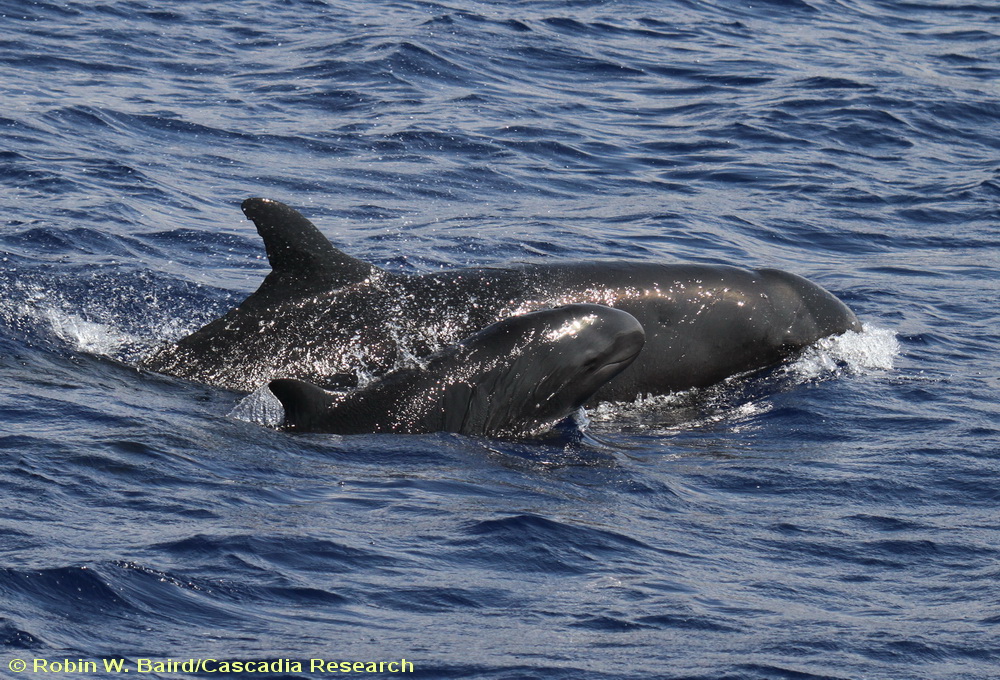
Have you ever heard of a false killer whale? False killer whales (FKWs), or Pseudorca crassidens, are large-toothed whales that live in tropical and subtropical oceans. Given their name, you’d think they would resemble a killer whale. However, they do not resemble killer whales at all.  FKWs are smaller and slimmer than killer whales and do not have white patches on their bodies. In 1846, scientists Richard Owen, John Edward Gray, and Johannes Theodor Reinhart found that the FKW skull highly resembled a killer whale’s skull, and thus gave this species its name: the “false killer whale.”


According to Dr. Robin Baird of Cascadia Research Collective, FKWs are very intelligent! False killer whales live in long-term, stable family groups like killer whales. They are also very social and share their catch with their family members. They actively forage, leap regularly, and often bowride.


Hawai‘i Populations
In 2017, NOAA Fisheries reported three distinct FKW populations in Hawaiian waters that do not breed with each other. There is a pelagic population, a Northwestern Hawaiian islands-associated population, and a main Hawaiian islands (MHI) population. The MHI population is the smallest, consisting of approximately 140 whales.


false killer whales


The MHI population is estimated to be half the size that it was in 1980. Aerial surveys undertaken from 1993 through 2003 by Joe Mobley of the University of Hawaiʻi West Oʻahu showed a steep decline in FKW sighting rates. Population surveys since the 1990s by Dr. Baird and colleagues indicate that the MHI population has continued to decline dramatically. In 2023, Dr. Janelle Badger of NOAA’s Pacific Island Fisheries Science Center, Dr. Baird and colleagues estimated the MHI population at 138 individuals, a decline of 5% per year. Due to its small population size, low reproductive rate, and continuing decline, the MHI “distinct population segment” was listed as Endangered under the Endangered Species Act in November 2012.


Diet and Foraging
FKWs are at the top of the food web in Hawaiʻi, and like most top predators, their population size is naturally smaller. According to Alison Stevens, predator populations are naturally lower because the prey populations need to be large enough to support the predator population. If predator populations are larger than prey populations, predators will eat all of the prey and then be without a food source.


FKWs hunt daily and eat larger pelagic game fish, including mahi-mahi, ono, aku, and ʻahi. According to NOAA Fisheries, they can dive for up to 18 minutes and catch prey up to 1000 meters deep.


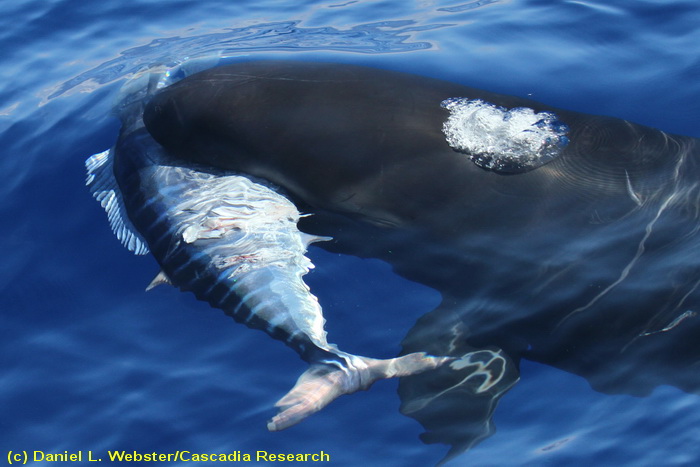
false killer whale feeding


It is a fantastic sight to witness FKWs hunting; they are known to throw their catch into the air before consumption. Like killer whales, they are also known to play with their catch before killing it. Since they prefer the same type of fish as humans, it creates competition between humans and FKWs. FKWs have been reported snatching fishermen’s fish off the hook or “depredating” their catch. In doing so, FKWs occasionally get hooked, which NOAA Fisheries considers one of the threats to the main Hawaiian Islands population.


Age and Reproduction
The oldest documented false killer whales were 63 years old for a female and 58 years old for a male. They have low reproduction rates with calving intervals of approximately seven years, which is one of the reasons why this population is so slow to recover when the population size is reduced. Unlike human gestation, which is nine months, FKWs’ gestation periods are 14-16 months. According to www.oceana.org, FKW babies are born about six feet long and will nurse for up to two years.


Identification
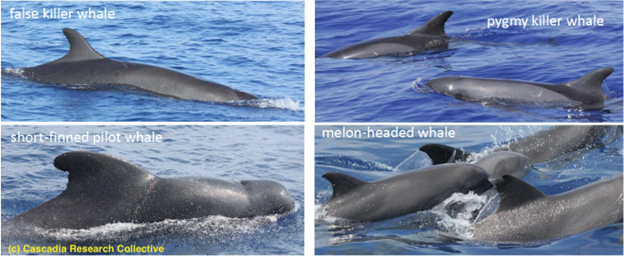
Three species of small black whales resident in Hawaiian waters look similar to the FKWs: the short-finned pilot whale (Globicephala macrorhynchus), the melon-headed whale (Peponocephala electra), and the pygmy killer whale (Feresa attenuata)

Above water, dorsal fin shots of the false killer whale, the pygmy killer whale, the short-finned pilot whale, and the melon-headed whale.


According to Dr. Baird, these whale species can be identified based on their dorsal fin size and position, head shape, and flipper shape. FKWs are approximately 5-17 feet and relatively large compared to the melon-headed whale and pygmy killer whale. Short-finned pilot whales have dorsal fins that are larger and further forward on the back than other species. Pygmy killer whales have rounded flippers and a rounded head when viewed from above. They also have a clear, distinct boundary beneath their dorsal fin. Melon-headed whales have pointed flippers and a pointed head when viewed from above. They have a very diffuse boundary beneath their dorsal fin, only visible under good lighting.


Main Threats
The primary threats to FKWs are the accumulation of pollutants and bycatch from commercial fishing. It is common for high-level predators like FKWs to accumulate high levels of pollutants in their bodies. The contaminants come from chemical runoff, such as agricultural pesticides, flame retardants, PCBs, and chemical detergents, which build up through the food chain. In 2009, Dr. Gina Ylitalo and her colleagues confirmed that MHI FKW had high levels of organic pollutants in their bodies by collecting and testing blubber samples. Some of these organic pollutants were at levels that could affect the animals’ health.

FKWs sometimes get entangled in fishing gear, and these whales are the most frequently bycaught species in the Hawaiʻi longline fishery.  NOAA Fisheries estimates that 10-15 are killed or seriously injured yearly. Humans have also been reported shooting the whales to prevent them from eating their catch.


FKW Hotspots
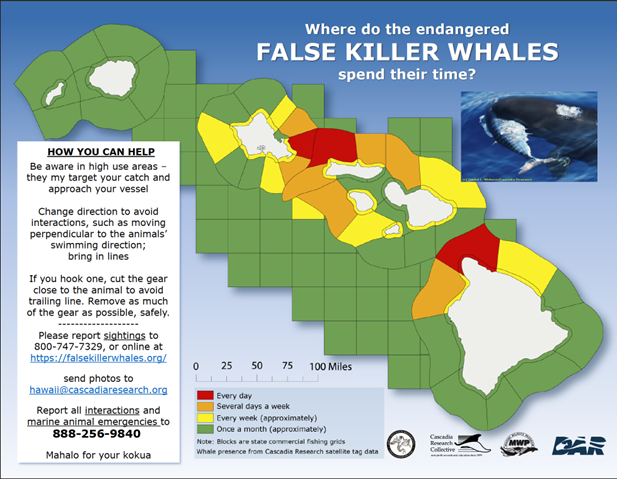
The Cascadia Research Collective has tagged over 50 false killer whales and tracked them via satellite to discover where they aggregate. Results show that FKWs range across depths of  25 – 2,700 fathoms and concentrate off Oʻahu, Molokaʻi, Lānaʻi, and the north end of Hawaiʻi Island. These findings provide direction for where the most effective efforts should be focused to monitor and mitigate FKW bycatch.

Map showing the areas where tagged false killer whales were found to spend most of their time.


What You Can Do to Help

  1. Help conserve endangered FKWs by being aware of high cluster areas while fishing. If you see FKWs, consider moving locations to avoid interactions and bring in your lines.
  2. Help us identify and track the FKWs by calling the hotline (1-888-256-9840) to report sightings and interactions. Your contributions will contribute to the “hotspots” database.
  3. Take above-water photos of their dorsal fins and send them to [email protected].


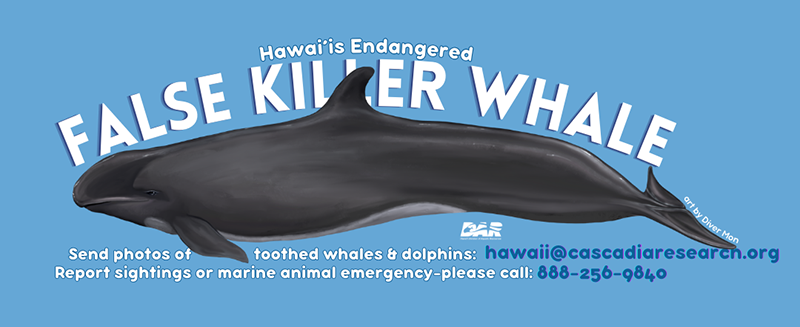
false killer whale reporting request


We appreciate your participation in protecting this critical species!


For further reading, see the whales and dolphins page on the DAR website


References


Badger, J. L., D.S. Johnson, R. W. Baird, A. L. Bradford, M. A. Kratofil, S. D. Mahaffy, T. Cullins, J. J. Currie, S. H. Stack, and E. M. Oleson. 2023. Long term abundance and trends of the endangered stock main Hawaiian Islands insular false killer whales (Pseudorca crassidens). NOAA Fisheries Pacific Islands Fisheries Science Center, Honolulu, HI. 25 pp.


Baird, R.W., A.M. Gorgone, D.J. McSweeney, D.L. Webster, D.R. Salden, M.H. Deakos, A.D. Ligon, G.S. Schorr, J. Barlow, and S.D. Mahaffy. 2008. False killer whales (Pseudorca crassidens) around the main Hawaiian Islands: long-term site fidelity, inter-island movements, and association patterns. Marine Mammal Science 24:591-612. doi: 10.1111/j.1748-7692.2008.00200.x


Baird, R.W., S.D. Mahaffy, A.M. Gorgone, K.A. Beach, T. Cullins, D.J. McSweeney, D.S. Verbeck and D.L. Webster. 2017. Updated evidence of interactions between false killer whales and fisheries around the main Hawaiian Islands: assessment of mouthline and dorsal fin injuries. Document PSRG-2017-16 submitted to the Pacific Scientific Review Group.


Bradford, A.L., R.W. Baird, S.D. Mahaffy, A.M. Gorgone, D.J. McSweeney, T. Cullins, D.L. Webster, and A.N. Zerbini. 2018. Abundance Estimates for Management of Endangered False Killer Whales in the Main Hawaiian Islands. Endangered Species Research 36: 297-313. doi: 10.3354/esr00903


NOAA Fisheries. 2017. False killer whales: Sentinels of ocean health. https://www.fisheries.noaa.gov/feature-story/false-killer-whales-sentinels-ocean-health#:~:text=Genetically%20different%20from%20their%20long,maoli%20counterparts%20do%20on%20land. Accessed May 2023.


NOAA Fisheries. 2022. False killer whale. https://www.fisheries.noaa.gov/species/false-killer-whale Accessed May 2023.


Oceana. False Killer Whale. https://oceana.org/marine-life/false-killer-whale/ Accessed May 2023.


Stevens, A. 2010. Dynamics of Predation. Nature Education Knowledge. https://www.nature.com/scitable/knowledge/library/dynamics-of-predation-13229468/#:~:text=Predator%20and%20prey%20populations%20cycle,allows%20prey%20populations%20to%20rebound.


Sea Watch Foundation. Is it a porpoise? Is it an orca? No! It’s a false killer whale!  https://www.seawatchfoundation.org.uk/is-it-a-porpoise-is-it-an-orca-no-its-a-false-killer-whale/ Accessed April 2023.


Ylitalo, G.M., R.W. Baird, G.K. Yanagida, D.L. Webster, S.J. Chivers, J.L. Bolton, G.S. Schorr and D.J. McSweeney. 2009. High levels of persistent organic pollutants measured in blubber of island-associated false killer whales (Pseudorca crassidens) around the main Hawaiian Islands. Marine Pollution Bulletin doi:10.1016/j.marpolbul.2009.08.029

10/1/23 – Trout comes to a close on Kauaʻi

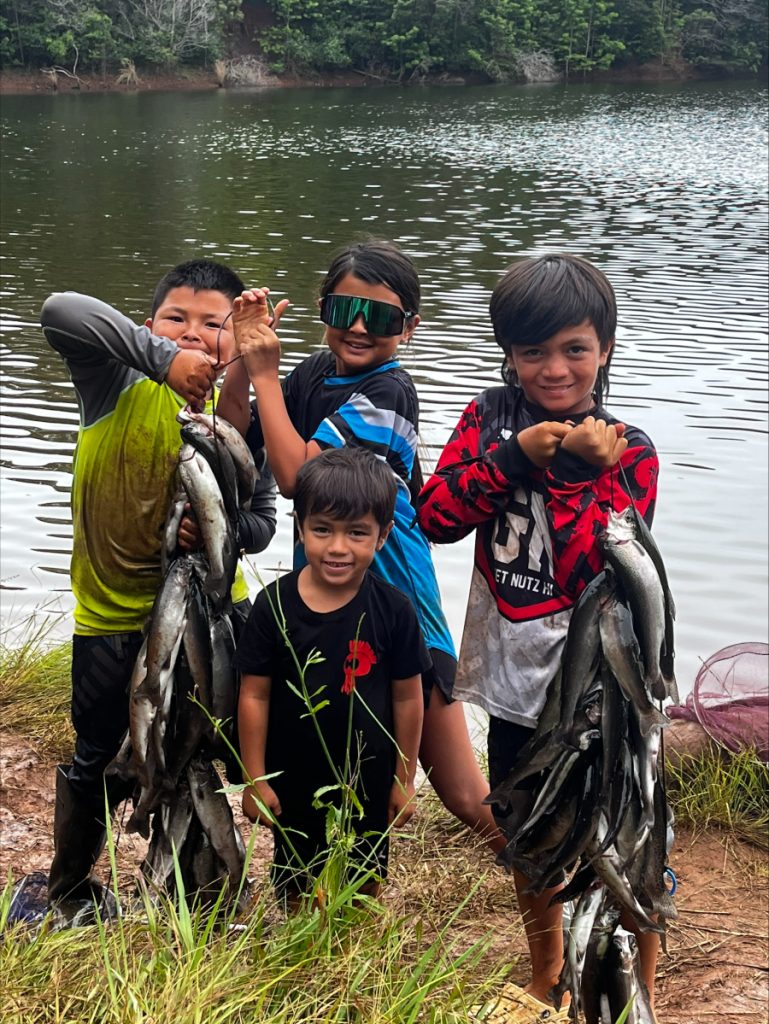
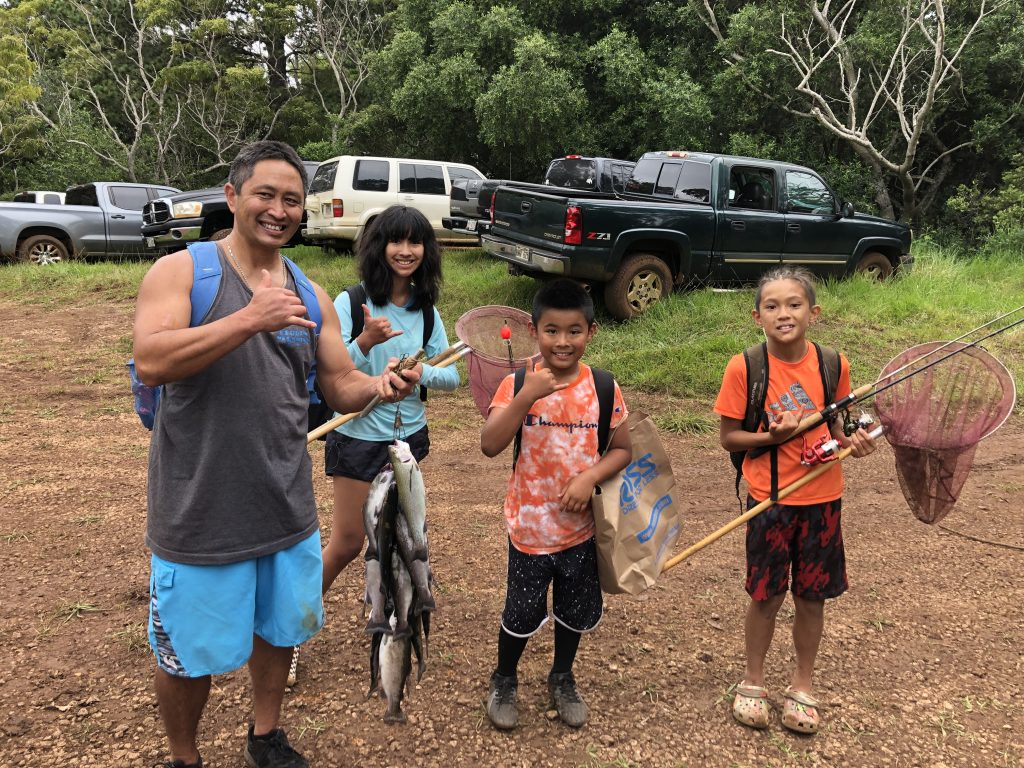
The 2023 trout season in Kōkeʻe, Kauaʻi came to a close on September 30th. 2800 anglers caught nearly 17,000 trout this year. Fishing remained strong even into August this year due to abundant rains in the spring and early summer that helped the trout to flourish as they were being reared by trout program technician Garrick Tatsuda. Next year’s trout have already been hatched at DAR’s Anuenue Fisheries Research Center at Sand Island and will be making the journey over to Kauaʻi in the coming months once the water in the reservoir cools down sufficiently.


To all who came out to fish this year, mahalo for supporting and enjoying the trout fishery program. For more than 100 years, the trout program has provided fun and family-focused fishing opportunities. Funding for the trout program is provided by the Sport Fish Restoration Act and sales of the Hawaii freshwater gamefish license.


A group of boys holding up a stringer of rainbow trout
Young fishers enjoy a bountiful catch at Pu’u Lua reservoir
A family shows of the fish they just caught
Heading home with mud on the shoes, a full cooler, and smiles on everyone’s faces means a successful day of trout fishing
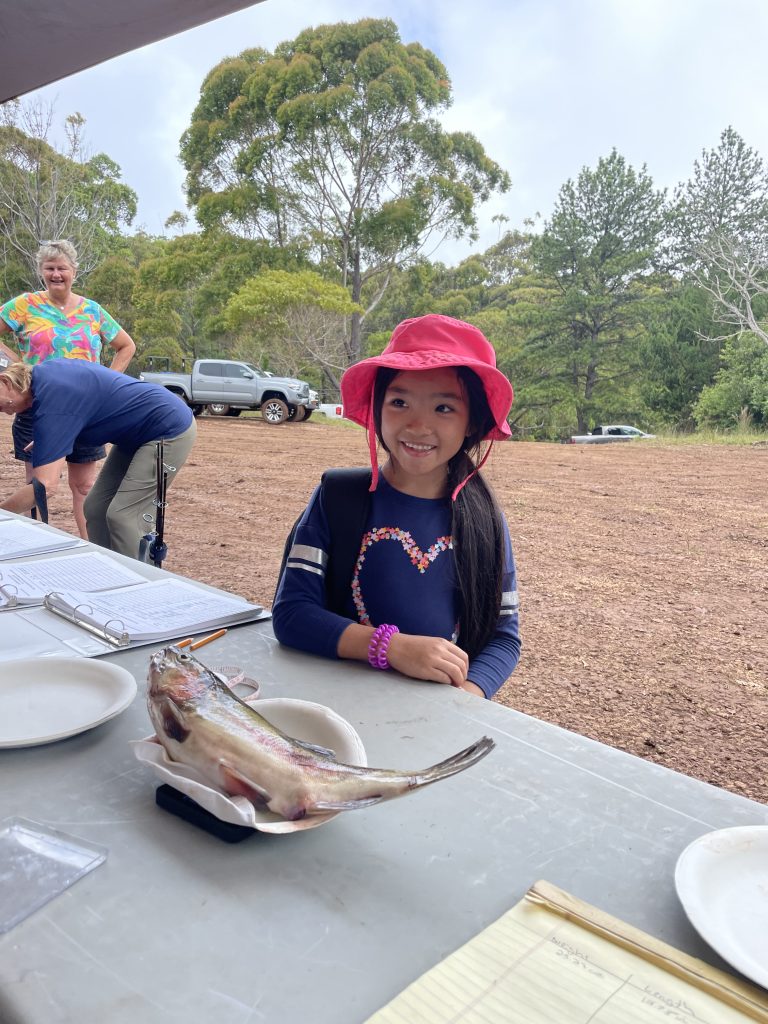
A girl weighs a fish she just caught
The biggest catch of opening day was by a young lady of just 6 years old! The trout weighed 2 1/2 lbs.

9/11/23 – DAR hosts Ta’ape Throwdown fishing tournament

Last weekend, DAR hosted the Taʻape Throwdown fishing tournament on Kauaʻi. The purpose of the tournament was to promote the harvest of the non-native taʻape (Lutjanus kasmira) as a sustainable and delicious food resource. Since their introduction in the 1950’s, this colorful snapper has exploded in population with schools of thousands roaming our reefs from the shoreline out to 400 feet deep. In their native range in French Polynesia, they are considered a prized food fish. However, in Hawai‘i they are often considered more of a nuisance than a desirable target for fishing. Despite this, their popularity is growing with sustainability-minded chefs, restaurant owners, and fishers. DAR partnered with Conservation International to put on the tournament as part of a shared goal to promote the taʻape fishery.

The tournament was a team tournament open to any legal methods of fishing. Just bring them in! We had a total of 6 teams bring in a combined weight of over 150 lbs of fish. Randall Takenaka of Kapaʻa had the winning catch of 79.1 lbs. and the largest fish at 0.85 lbs. Team “What About Da Fishaman” took home top prize in the youth category with 33.05 lbs., especially impressive because they were all caught from shore.

Chef Mark Oyama of Mark’s Place Restaurant and a team of volunteers were on site to clean and fry up the fish for folks to enjoy while they checked out info tables from DAR, NOAA, and CI. Dr. Tim Grabowski, an ichthyologist with University of Hawai‘i at Hilo, and biologists with DAR’s Aquatic Invasive Species team collected data for Dr. Grabowski’s research on the growth rates and life history of the taʻape. The fish were measured, photographed and had their otoliths extracted, which is a tiny bone found in the skulls of fish that can be used to age a fish by counting the growth rings, much like you would with a tree.   

Whether you are on angler, a conservationist, or just someone who likes to eat tasty fish, fishing for taʻape is something we can all enjoy and feel good about knowing it is helping our reefs. You can visit Conservation International’s Taʻape Project web page to learn more about this fish and find recipes, videos, and more.

DAR would like to thank our partners and sponsors for donating prizes and helping to make this tournament a success. Financial support for the tournament was provided by a grant from the Federal Aid in Sport Fish Restoration program.

Taʻape Throwdown 2023 Sponsors:
Conservation International
Kaua‘i Sailing Association
Lihue Fishing Supply
Mark’s Place Restaurant
Hanapaʻa Fishing Kauaʻi
Seasport Divers
Holoholo Charters
Spearo Kaua‘i
Hammerhead Spearguns
Venture Wetsuits
NOAA Fisheries

Randal Takenaka of Kapaa took home the grand prize of a cooler and gift certificates from Holoholo Charters and Venture Wetsuits
Team “What About Da Fishaman” took top prize in the youth category

9/1/23 – DAR brings enforcement action against owners of the Nakoa in February 2023 grounding

By Charlie Taylor, DAR Legal Research Specialist

In February of 2023, a 94-foot luxury yacht named Nakoa grounded onto the rocky coastline of Honolua Bay, Maui, causing considerable damage and angst among community members of northwest Maui, as well as angering Hawaii residents as a whole. Honolua Bay is an important site for environmental, cultural, and recreational activities, and the image of a large super-yacht from off-island grounded onto the shore while leaking fuel into this sacred site left an indelible imprint on community members who regularly frequented the Bay, and the incident made international headlines.

The Nakoa leaking fuel after grounding in Honolua Bay, Maui
DOCARE officers on the scene assessing the situation

The DAR administrative enforcement team, recognizing the cultural importance of Honolua Bay and the pain this event caused our West Maui ohana, made a concerted effort to bring an administrative enforcement action before the Board of Land and Natural Resources sooner rather than later. DAR biologists from Maui set to work immediately to assess the damage caused by the grounding to the underlying live rock and coral reef. Our biologists documented over 100 coral colonies and more than 1,900 square meters of live rock that were damaged by the Nakoa grounding. The team calculated the damage to natural resources using DAR’s coral and live rock penalty matrices and then calculated DLNR’s staff costs and came to a total fine of over $117,000.

A large coral colony damaged by the Nakoa grounding incident
A natural ledge of live rock completely smashed as a result of the Nakoa grounding incident

The penalty of $117,000 did not satisfy many from the Maui community, and their lack of satisfaction was understandable. DAR staff calculates natural resource damage in a consistent, uniform way, and we base our calculations on precedent from earlier damage events. We are able to place a monetary value on coral and live rock, but how can we calculate the value of cultural resources lost? The short answer is we can’t, but the Board can use its discretion to levy additional or elevated penalties based on feedback from the community and its own judgment.

The night before the Board meeting, the team worked and negotiated late into the night with the owners of the Nakoa (not the operators) and reached a settlement whereby the owners would pay the full settlement amount of $117,000 while leaving the door open for the Board to levy additional fines and penalties against the operator of the vessel at a later date. The settlement funds will be paid to DLNR, and DLNR anticipates using these funds for coral, live rock, and other aquatic resource restoration activities.

The team’s decision to focus on this incident, quickly gather information, assess fines and penalties, and bring our findings to the Board in an expedited manner proved to be a fortuitous decision as the northwest Maui community of Lahaina was devastated by the most destructive wildfire in Hawaiian history just 10 days later. The Nakoa grounding incident, while tragic, pales in comparison to the loss of life and property that occurred in Lahaina and the surrounding area on August 8. Still, the team took some solace in the fact that we were able to deliver some justice, however incomplete, to the West Maui community before the Lahaina wildfire tragedy unfolded. Although it may be many, many months before the West Maui community is ready to grapple with the Nakoa grounding incident again, the DAR administrative enforcement team will be ready to advise and assist the Board when it’s ready to revisit the incident and bring justice to the operator of the vessel.

8/7/23 – How is stream ecology connected to coastal fishing?

Contributed by: Kim Peyton, Heather Ylitalo-Ward, Neal Hazama, Tim Leichliter, Troy Shimoda, Troy Sakihara, Jody Kimmel-Brown, Tim Shindo

On a recent estuary survey at Waimea River on Kauaʻi, the DAR Estuary Team was able to document an amazing migration of tens of thousands of hinana (post-larvae of ‘o‘opu wai) as they entered the stream mouth estuary on their way to freshwater habitat.  Luck that day continued with a coinciding feeding frenzy by juvenile (pua) āholehole (Kuhlia xenura).

However, Waimea is no stranger to this type of event, as described in an ‘ōlelo no‘eau (Hawaiian proverb) —Ka i‘a ho‘opā ‘ili kanaka o Waimea, The fish of Waimea that touch the skins of people.  When it was the season for hinana, the spawn of ‘o‘opu, at Waimea, Kaua‘i, they were so numerous that one couldn’t go into the water without rubbing against them (Puku‘i 1983). These experiences on the Westside of Kauaʻi supported lessons shared by kūpuna, as Waimea River revealed how our streams, estuaries, and marine ecosystems are all interconnected. Streams feed estuaries and estuaries are the nursery grounds for many marine species.  

A successful ‘o‘opu nopili adult settled in Honomanū Stream on Maui. ‘O‘opu nopili are usually found in the greatest numbers above the first significant waterfall.

With an early morning low tide, freshwater flow to the ocean was strong because the Pacific wasn’t holding Waimea River back. Along the very edges of the river shoreline, where the shallowness of the water slows down flow velocity, hinana were swimming upstream. Impressively determined swimmers at about 5/8 inches long,  we watched as hinana piled up behind boulders inside the river mouth. Here these newly arrived fish waited for the tide to turn, before setting off again on the last segment of their journey to adult habitat.  A journey that, depending on the species of ‘o‘opu, can include climbing waterfalls.

Thousands of hinana, seen here as a dark brown curve in the center of the photo, are lining up in the lee of a boulder waiting for the tide to slacken. When slack tide started, we checked this area again and confirmed that the hinana had moved upstream.

To identify and measure fish that benefit from estuaries, one monitoring method the DAR Estuary Team developed relies on cast nets. Some casts hauled in hinana, allowing us to photograph and determine—thanks to Skippy Hau’s expertise—that this freshwater species recruiting to Waimea River was ‘o‘opu nopili (Sicyopterus stimpsoni). Although their bodies are mostly clear as planktonic larvae floating in ocean currents, ‘o‘opu nopili become pigmented with a distinct striped pattern upon entering estuaries. ‘O‘opu nopili typically climb waterfalls to reach their preferred adult habitat.

‘O’opu nopili hinana from Waimea River, Kauaʻi. Note the distinct banding pattern of these post-larvae.

Juvenile āholehole, 2 to 3 inches long, were also caught in the cast net. Remarkably, all these pua had overstuffed midsections. Two āholehole were dissected to determine if their bulging stomachs were from gorging on migrating hinana. One āholehole had a stomach full of six hinana, a remarkable amount of food for such a small fish. To our surprise, the other āholehole had eaten at least 14 juvenile ‘ōpae. Examining the stomach contents of the second āholehole yielded information that would have gone undetected otherwise. Migrating juvenile ‘ōpae kalaʻole (Atyoida bisulcata) are challenging to see because their bodies are still mostly clear as they transit through estuaries. We recorded two stream species recruiting to Waimea River while monitoring, and āholehole pua took advantage of this bounty by preying on hinana and ‘ōpae during their obligatory movement between marine and freshwater ecosystems.

Āholehole pua with a full belly.
Not all the āholehole pua gorged on hinana, some preyed on migrating juvenile ‘ōpae kalaʻole. This fish consumed at least 14 ‘ōpae kalaʻole in the estuary.
Even though this āholehole pua was only 2-3 inches long it had consumed at least six hinana. Notably, āholehole pua swallow hinana whole.

These events in Waimea River captured a critical ecological balance between streams and estuaries. Hawaiian streams are mostly shallow,  narrow waterways that lack adequate space and food resources to support tens of thousands of individuals from each of our nine stream species. Only the strongest and luckiest juveniles complete a journey to their adult habitat in the upper stream reaches. The majority serve another essential ecological role as food for rapidly growing pua, such as āholehole. Productive streams offer reliable sources of food in estuaries. For this reason, healthy streams and estuaries that attract tens of thousands of recruiting hinana and ‘ōpae play significant roles in sustaining coastal resources.

Mahalo to Klayton Kubo for his input to the DAR Estuary Team.  As a result, Waimea River on Kauaʻi was added to our monitoring rotation of 13 estuaries statewide.  On Kauaʻi the DAR Estuary Team monitors the estuaries at the mouths of Waimea River, Hanalei River, and Anahola River four times per year. DAR Kauaʻi staff join in this effort, and we all learn quite a lot from these shared experiences.

This work is funded by US Fish and Wildlife Service Sportfish Restoration program and the State of Hawai’i.