


State of Hawai'i
Division of Aquatic Resources
Closed during 2025, Open during 2026
Trout season closed until summer 2026
Pāku‘iku‘i closed until Dec 2026

A Unique Fishing Class
DAR Education Specialist John Kahiapo regularly teaches a fishing class at Wailoa Station in Hilo, Hawai‘i Island. The class targets those who have violated fishing regulations if the prosecutor, public defender, and judge deem it appropriate. Fishers who attend the class learn the rules to avoid violating fishing regulations in the future. Then, they can take that knowledge back to their communities to help increase compliance with fishing regulations on Hawai‘i Island.
The class covers regulated species, marine protected areas, protected marine animals, and fishing gear. He also teaches people how to use materials he provides, such as regulations booklets and the popular measurement guides that give the minimum size, season, and bag limit for each regulated species. The class takes two hours and goes over everything a fisher needs to know to stay on the right side of the law.
“Fishing is a privilege that we get to enjoy in Hawai‘i,” Kahiapo said. “It’s every fisher’s kuleana to familiarize themselves with the rules.”

Education for All Ages
Kahiapo teaches other introductory fishing education classes to children as well as adults. He also travels to schools to give talks on various aquatic resource topics. Part of his job as an education specialist for DAR is to help people understand what the rules are and why they exist. For example, size restrictions ensure that fish get old enough to spawn before they are taken from the ocean. Regulations are part of the way the State government hopes to make sure that there will still be fish for future generations.
“The rules all exist for a reason,” Kahiapo explained. “With the ‘ama’ama, also known as striped mullet, some are actually capable of spawning when they are seven inches long. However, we want to make sure they produce a few generations before they can be taken. That’s why the regulations require them to be 11 inches or more before they are taken.”
“In-person courses like this are helpful,” Kahiapo said. “People can touch the gear and understand how it is used, ask questions, and have discussions about things they don’t understand.”
Managing our Aquatic Resources
Education is a crucial aspect of DAR’s mission, and it’s not just for fishers. Tour operators, conservationists, people who enjoy ocean sports, and many other stakeholders benefit from understanding responsible resource management. It is only with community support that the government can succeed in being a good steward of land and ocean resources, and education is a meaningful way to get them involved.
“This course is also given at different public events,” Kahiapo said. “I set up a fishing education table for groups who request it, and in this way we can help communities know everything they need to know about marine life management.”
DAR provides a variety of helpful information to the public. For example, fishers who take Kahiapo’s class go home with a copy of the most recent fishing regulations, a guide to regulated species and how to measure them, and a manual on fishing in Hawai‘i. These materials ensure that what they learned in the course will stick with them and be easy to share.
Fearless Fish

If you hear divers talking about being more scared of ulua (Giant trevally) than sharks, they are most likely talking about diving in Papahānaumokuākea! This is one of the few places in the Hawaiian archipelago where it is guaranteed that on every dive you will encounter either an ulua or a shark, usually multiple! And if you’re unlucky, there’s a higher chance of you getting bitten by an ulua than a shark. Yes, that has happened before! But that is what a healthy, marine ecosystem looks like – a truly thriving reef should be dominated by apex predators such as sharks, jacks, and snappers. Due to the remoteness of Papahānaumokuākea, wildlife are not used to seeing humans and therefore are very curious. Sometimes too curious. It’s not uncommon to get close fly-bys from ulua and sharks!
RAMPing up Research
This past summer, the Division of Aquatic Resources’ (DAR) Aquatic Biologist Anita Tsang and senior technician Richard Chen from the Aquatic Invasive Species program had the privilege to join the 2025 National Oceanic & Atmospheric Administration’s (NOAA), Office of National Marine Sanctuaries (ONMS) Reef Assessment and Monitoring Program (RAMP) research cruise up to Papahānaumokuākea. The 24-day trip included stops at Lalo (French Frigate Shoals), Kamole (Laysan), Kapou (Lisianski), Hōlanikū (Kure), Manawai (Pearl & Hermes), and Kuaihelani (Midway) where fish, coral health, limu, and urchin surveys were conducted.

Research on the Reef
Anita was diving as part of the coral health survey team, along with Kailey Pascoe (PhD candidate at University of Hawai‘i at Hilo and researcher from MEGA Lab) and Ethan Nash (NOAA). Coral health surveys included doing fish species and size counts, documenting all coral species and health conditions along the study transect, and conducting Structure from Motion (SfM) surveys that allow the creation of 3D photomosaic models of the reef. These coral health surveys contribute to a long-term dataset that is about 20 years long and provide resource managers important information around coral conditions in Papahānaumokuākea such as presence (or absence) of diseases, bleaching, predation, and other signs of stress.

Interestingly, even though Papahānaumokuākea is generally considered a ʻpristine’ area with healthy reefs, it was saddening to see that several reefs out there were still recovering from past bleaching and hurricane events. Reefs that had suffered high coral mortality from the 2014/2015 bleaching event and the hurricane that hit Papahānaumokuākea in 2018 still had low coral cover, but it was promising to see many new recruits slowly coming back. Nevertheless, there were still healthy reefs with high coral cover, and it was amazing to see a lot of coral diversity that is not commonly seen in the Main Hawaiian Islands!
Looking Closely at Limu

Richard participated in the limu (algae) and urchin surveys which were new additions to the RAMP cruise this year. Historically limu has been understudied on these RAMP cruises, relative to corals and fishes. However, limu and urchins play an important ecological role in coral reefs. Limu is a major food source for many marine life such as fishes and urchins, and the grazing or feeding on limu by these animals is critical to maintain balance on the reef as algal blooms can overgrow and smother corals. Monitoring limu and urchins allow managers and researchers to get a better picture around the general health of a coral reef.
A nuisance alga, first noted in 2016, inspired this year’s limu surveys. In 2016, researchers discovered an unusual red limu growing in thick mats at Manawai. Within three years, subsequent cruises were shocked to find that this unknown alga had begun to spread rapidly over multiple reefs, killing a lot of corals and other native limu. In 2020 the limu was assigned the name Chondria tumulosa, and by 2023 it had spread to Kuaihelani and Hōlanikū. During the RAMP cruise this year, anecdotal observations revealed that a lot of the C. tumulosa have appeared to die back, but there were still several reefs that had high cover of the red alga and many reefs that were previously covered by C. tumulosa were dead. The limu and urchin surveys will allow us to continue to monitor C. tumulosa populations and other unusual changes in benthic composition. DAR is also currently working with University of Hawaiʻi researchers and NOAA to better understand the life history characteristics of this limu and what might cause these blooms.
Seven Sentries
DAR is one of the seven co-managing agencies that work together as a collective to manage and preserve the biological, cultural, and historical significance of the Papahānaumokuākea Marine National Monument. The State of Hawaiʻi is also a co-manager of Papahānaumokuākea National Marine Sanctuary with NOAA ONMS. DAR hopes to continue to partner with NOAA ONMS on the RAMP research cruises to better manage and protect the unique resources of Papahānaumokuākea and is looking forward to ongoing collaboration and expansion of co-management partnerships to support Papahānaumokuākea.
Authors: Anita Tsang and Richard Chen


2025 Trout Season Summary


The Art of Casting
The midmorning sun already sits high in the sky, its rays piercing the shallow waters of Waikiki. The fisherman moves steadily through the cool, waist-high waves as they lap gently against him, his throw net segmented into thirds and ready for launch. Several yards ahead, his quarry– a school of weke(goatfish), stirs anxiously beneath a pier. They are familiar with this scenario and the danger it presents, but they are not yet ready to risk potential predators awaiting them in deeper waters. “The shade helps them feel safe.” explains fisherman Neal Hazama. With decades of experience guiding his movements, Neal gauges the remaining distance, braces against the wind, and throws! The net blossoms like a flower in mid-air before splashing down in a near-perfect circle over the heart of the school, its weights quickly bringing it to the bottom. Success! Over two dozen of the goatfish have been ensnared, and Neal begins to haul his catch to shore. These fish are not destined for the dinner plate however. Instead, they have the honor of contributing to over 25 years of scientific data, before being released back where they were caught.
The Process of Processing
Every month Neal conducts a shoreline sampling survey of Waikiki with his thrownet, starting from Kaisers and ending all the way at the Diamond Head lighthouse. The purpose of this ongoing study helps to assess not only the biodiversity of Oahu’s nearshore waters, but the species density as well. Often, Neal is able to identify the species, number, and size range of the fish by sight alone, but it is when he lets his net fly, that things really get interesting.

As Neal approaches the beach, I hurry to fill a five gallon bucket with seawater and haul it to dry land. A portable air pump is added to maintain oxygen levels and as the fish are dropped in, I produce a measuring shoot and tagging kit from our dive bag. With practiced efficiency, Neal measures the length of the fish from snout to tail fork, while I record the data. Then, a plastic tag with an identification number and phone number is imbedded just under the animal’s skin before we release it out to sea once more.
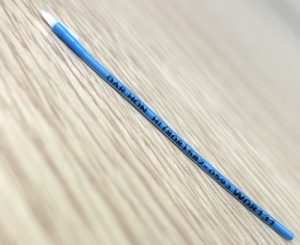
If you or anyone you know catches this fish in the future, feel free to keep your catch, but we appreciate it if you contact the included phone number to report it (808.587.0593), the tag can help DAR identify the individual and compare how much it has grown and how far it has travelled since its original capture. The over two decades’ worth of cumulative data from these catching and tagging studies is critical in influencing some of the regulations put in place with regards to fish bag limits and catch sizes. It isn’t only weke, either. Moi(thread fin) are also tagged, but visual confirmation still provides valuable data on all species, especially those valuable to fishermen, such as aholehole(flag tail), ʻōʻio(bonefish), and kala(unicorn fish).
Cultivating Community

Neal’s work seldom goes unnoticed by the public and we are frequently engaged by visitors and locals alike, providing a prime opportunity to engage with them in an impromptu information and education session. Some especially enthusiastic and lucky keiki are even permitted to help with the fish release as a way to encourage their burgeoning interests in fishing and marine biology. There are many more watermen and lifeguards who already recognize Neal and don’t hesitate to great him with a smile and a wave of aloha.
Neal always returns the smile, “After doing this some 25 years, you start to remember people.”
At the same time, Neal is always considerate to give space to others using the sea, such as kids bodyboarding, nearshore fishermen, and even monk seals sleeping on the beach. As important as this study is, the ocean is a shared space and it is important to maintain good relationships. Perhaps equally valuable to the data gathered from this shoreline sampling are the lessons it imparts: to live with aloha.
by Charles Lee
DAR Education Specialist of Oahu