Learn & Explore/Species/Introduced & Invasive/Nile Tilapia
Nile Tilapia
Category: Invasive
A fast-growing tilapia that outcompetes native Hawaiian fish.
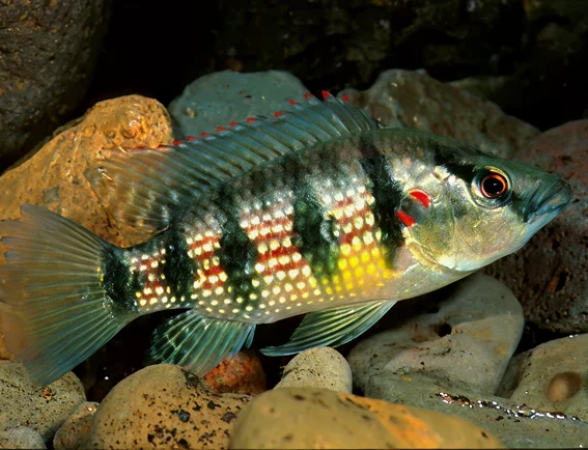
Nile Tilapia (Oreochromis niloticus)
-
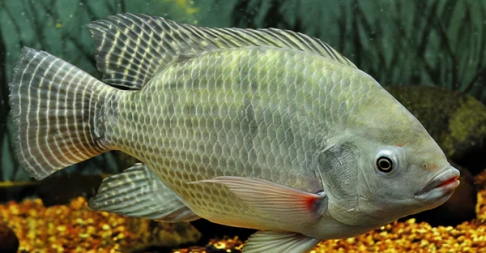
Distinctive vertical stripes on caudal fin and soft dorsal fin 3, 4, 11
-
Red head coloration in breeding males 3, 11
-
Can reach more than 5kg
Habitat
-
Fresh and brackish waters 1
-
Prefers 31-36 ℃
Impacts & Concern
-
High potential to invade and establish itself in almost all tropical regions (Zambrano et al. 2006) and adapt to non-native environments 7
-
Can hybridize with aquaculture stock and be released into the wild (Costa-Pierce 2003) and has already hybrized in Hawaiʻi with Mozambique Tilapia (Oreochromis mossambicus) (Wu and Yang 2012) and blue tilapia (O. aureus) 12
-
May negatively impact native fish (Martin et al. 2010) like ʻoʻopu alamoʻo (freshwater goby) 5
-
Reported as a nuisance catch when fishing for ‘ama‘ama or striped mullet (Mugil cephalus)
Introduction
-
May have been brought from Taiwan in 1980 for aquaculture (Wu and Yang 2012) and possibly later escaped 10
-
Most introductions are a result of aquaculture
Distribution in Hawai‘i
-
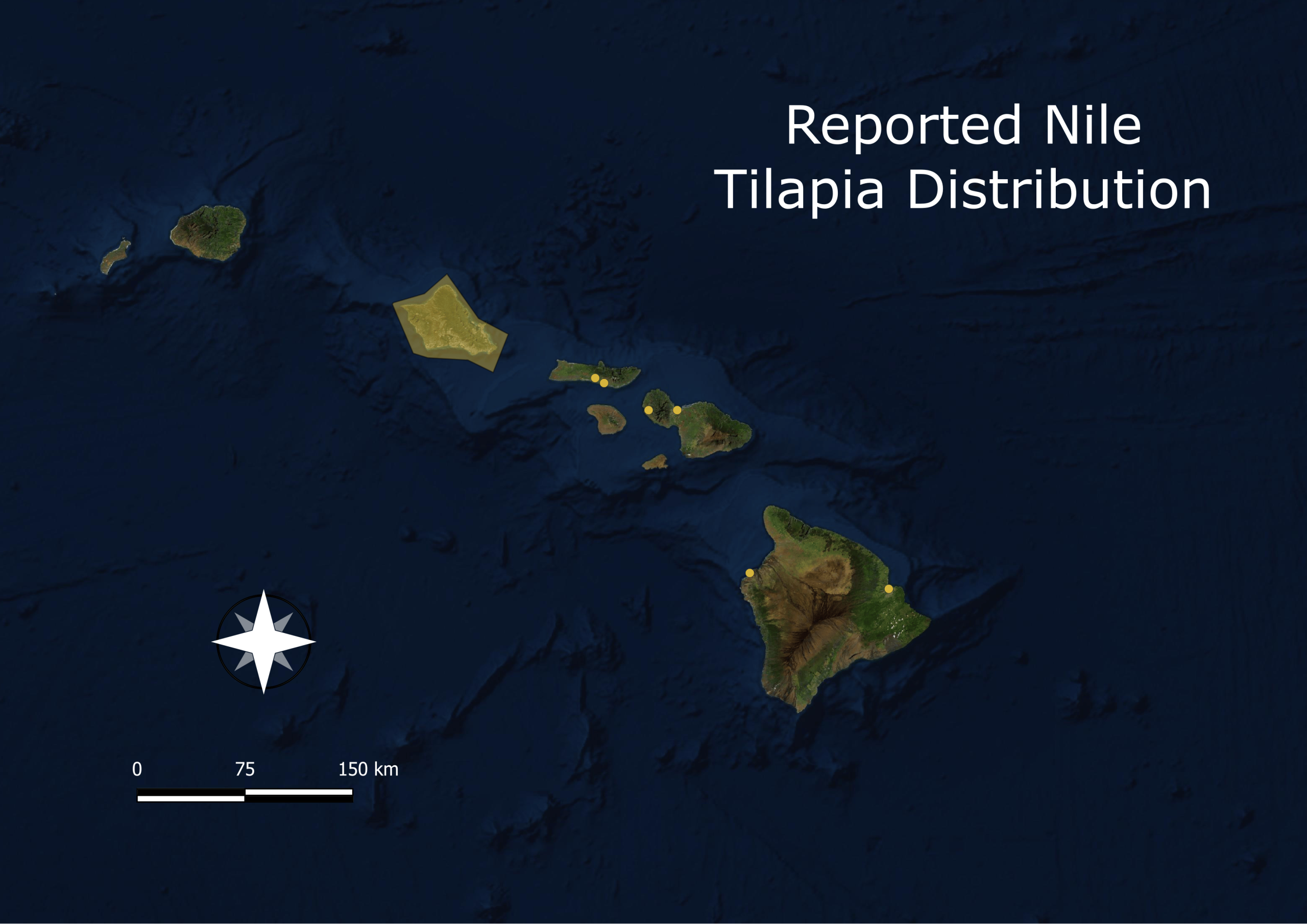
Kauaʻi: Not documented
-
Oʻahu: Present in aquaculture 9,12
-
Molokaʻi: Kawela Stream, Kaunakakai Ditch 13
-
Lānaʻi: Not documented
-
Maui: Lahaina Stream, Kahului Stream 13
-
Hawaiʻi Island: ʻAlenaio Stream, Hilo 12,13
* The species is also present in the state in aquaculture sites indicated by the polygon
Regulations
-
Restricted for private and commercial use including research, zoological parks, aquaculture production or non-profit research (§4-71-6.5)
-
Does not include individual possession of an animal as a pet
Related Management ProjectS
-
2020 fishing tournament in Hilo caught 75 lbs of tilapia and 85 lbs of other non-native fish species.
-
‘Ama ‘ama fishermen are encouraged to consume Nile tilapia by catch
References
-
CABI (2019). Oreochromis niloticus (Nile tilapia) In: Invasive Species Compendium [Data set]. CAB International. https://www.cabi.org/isc/datasheet/72086
-
Costa-Pierce, B.A. (2003) Rapid evolution of an established feral tilapia (Oreochromis spp.): the need to incorporate invasion science into regulatory structures. Biological Invasions, 5, 71–84. https://doi.org/10.1023/A:1024094606326
-
de Moor, I.J., & M.N. Bruton. (1988). Atlas of alien and translocated indigenous aquatic animals in southern Africa. South African National Scientific Programmes Report 144. Foundation for Research Development and Council for Scientific and Industrial Research.
-
Hasan, V. & Tamam M.B. (2019). First record of the invasive Nile Tilapia, Oreochromis niloticus (Linnaeus, 1758) (Perciformes, Cichlidae), on Bawean Island, Indonesia. Check List, 15(1), 225–227. https://doi.org/10.15560/15.1.225
-
Martin C.W., Valentine M.M., & Valentine J.F. (2010). Competitive Interactions between Invasive Nile Tilapia and Native Fish: The Potential for Altered Trophic Exchange and Modification of Food Webs. PLOS ONE, 5(12), e14395. https://doi.org/10.1371/journal.pone.0014395
-
Mitchell, C., Ogura C., Meadows D.W., Kane A., Strommer L., Fretz S., Leonard D., & McClung A. (2005). Hawai‘i’s Comprehensive Wildlife Conservation Strategy. Department of Land and Natural Resources. Honolulu, Hawai‘i. 722 pp.
-
Peterson, M., Slack, W., Grammer, G., Finley, J., Woodley, C., & Partyka, M. (2006). Foraging in non-native environments: comparison of Nile tilapia and three co-occurring native centrarchids in invaded coastal Mississippi watersheds. Environmental Biology of Fishes, 76, 283–301. https://doi.org/10.1007/s10641-006-9033-4
-
Randall, J. E. (1987). Introductions of marine fishes to the Hawaiian Islands. Bulletin of Marine Science, 41(2), 490-502.
-
Soto, E., McGovern-Hopkins, K., Klinger-Bowen, R., Fox, B., Brock, J., Antonio, N., van der Waal, Z., Rushton, S., Mill, A., & Tamaru, C. (2013). Prevalence of Francisella noatunensis subsp. orientalis in cultured tilapia on the island of O‘ahu, Hawai‘i. Journal of Aquatic Animal Health, 25, 104–109. https://doi.org/10.1080/08997659.2013.781554
- Szyper, J.P., Hopkins, K.D., Malchow, W., & Okamura, W. Y. (2000). History and Prospects of Tilapia Stocks in Hawai‘i, U.S.A. In Tilapia Culture in the 21st Century–Proceedings from the Fifth International Symposium on Tilapia Aquaculture, Rio de Janeiro, Brazil.
- Trewavas, E. (1983). Tilapiine Fishes of the Genera Sarotherodon, Oreochromis, and Danakilia. The Dorset Press. https://doi.org/10.5962/bhl.title.123198
- Wu L., & Yang J. (2012). Identifications of Captive and Wild Tilapia Species Existing in Hawai‘i by Mitochondrial DNA Control Region Sequence. PLOS ONE, 7(12), e51731. https://doi.org/10.1371/journal.pone.0051731
-
Yamasaki, L.S., Iwai, T., Klinger-Bowen, R.C., Weese, D.A., Fowler, C.E., Yacoub, J.L., & Wong, M.A. (2022). Identification of Nile tilapia (Oreochromis niloticus) and its hybrids in natural environments in Hawai‘i. Aquaculture, 550, e737805. https://doi.org/10.1016/j.aquaculture.2021.737805
-
Zambrano, L., Martínez-Meyer, E., Menezes, N., & Peterson, A. (2006). Invasive potential of common carp (Cyprinus carpio) and Nile tilapia (Oreochromis niloticus) in American freshwater systems. Canadian Journal of Fisheries and Aquatic Sciences, 63. https://doi.org/10.1139/F06-088