Learn & Explore/Habitats/Streams/Cultural Importance
Cultural Importance
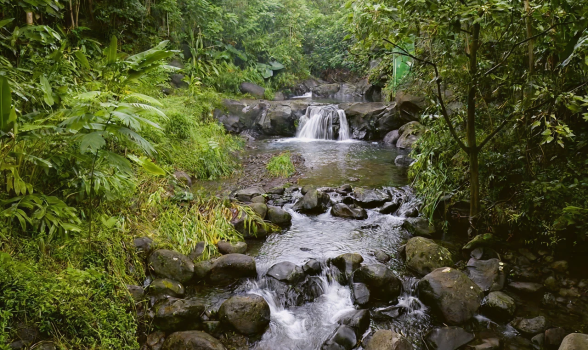
In Hawaiian culture, streams are sacred, sustaining water, food, and community life.
Native Hawaiians and Streams
- From ancient times, and continuing on until today, streams are one of the most valued natural resources for native Hawaiians.
- Various Hawaiian cultural traditions and practices involving streams rely on the health and survival of this natural resource.
- Freshwater, called wai, is considered sacred.
- It is understood that one should only take the amount of wai truly needed to live – nothing excessive.
- Sharing of wai is a cultural expectation, and is done without greed or selfishness.
- This principle of equal sharing formed the word kānāwai, meaning “the law” or “equal sharing of water.”
- Water symbolizes wealth – since wai means water, the word waiwai means abundance and prosperity.
How Streams Shape Native Hawaiian Lifestyle
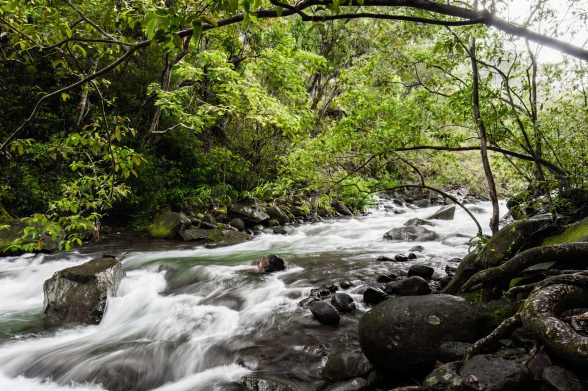
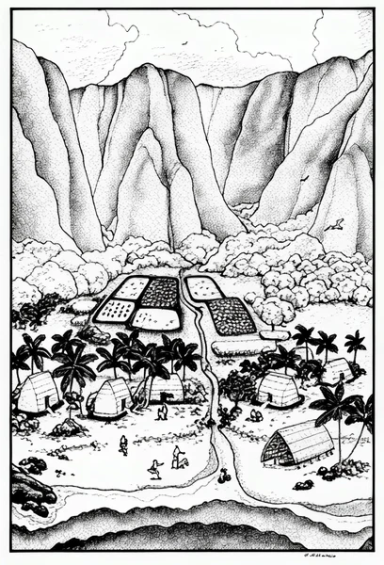
- In ancient Hawaiʻi, communities lived within ahupuaʻa, land divisions extending from the mountains to the sea, which were typically organized around the presence of kahawai, or streams.
- The ahupuaʻa would usually be comprised of three main, interconnected zones: uka (mountain), kula (plain), and kai (ocean).
- Even though these zones are different, they are understood to be connected by the streams running through them from the mountains to the ocean.
- Streams provide essential resources that support daily life and cultural practices and traditions.
Water From The Mountains
Mountain streams help certain plants grow, providing materials for:
- Medicine
- Timber for canoe building
- Plant for nets, fishing lines, and canoe lashings
Water In The Plains
Freshwater flowing in the plains, or the central lands where residents live, are used for agriculture and cultivating crops such as:
- Kalo (taro)
- Maiʻa (banana)
- ʻUlu (breadfruit)
- ʻUala (sweet potato)
- Kō (sugar cane)
Kalo is especially important – grown in flooded fields called loʻi kalo, which require clean, cool, and continuously flowing water to thrive.
Hawaiians build irrigation channels called ʻauwai to direct water to their fields.
After watering fields, the excess water is returned to the streams so communities downstream can also use it.
Hawaiians build irrigation channels called ʻauwai to direct water to their fields.
After watering fields, the excess water is returned to the streams so communities downstream can also use it.
Water Near The Ocean
- Water near stream mouths are known as important estuarine areas, that act as nurseries for various fish and shellfish species.
- With this understanding, Hawaiians build loko iʻa, or fishponds, near stream mouths to support fish, shrimp, and algae growth in the mix of fresh and salt water.
- At one point, about 500 traditional Hawaiian fishponds operated and existed across Hawaiʻi.
Freshwater Species
Certain amphidromous animals, which were important food sources for ancient Hawaiians, are washed downstream into the ocean as larvae and eventually migrate and move back upstream as juveniles becoming:
- ‘O‘opu (gobies)
- ‘Ōpae (freshwater shrimp)
- Hīhīwai (freshwater snails)
The Life Force of Hawaiian Culture
- Streams are absolutely essential to the daily life and culture of the Hawaiian people.
- Hawaiians are careful to keep stream water clean as it travels in its natural path from uka – kula – kai.
- Healthy, free-flowing streams are necessary for native plants and animals to survive.
- Without these natural resources, Hawaiian communities would not be able to thrive and maintain their health.
- Streams are – and will forever continue to be – a vital part of Hawaiian cultural and societal well-being.