

Learn & Explore/Programs & Initiatives/Sportfish Restoration Fund/Fish Aggregating Devices
Fish Aggregating Devices (FADs)
Offshore buoys designed to attract pelagic fish and improve fishing access.
Fish Aggregating Devices (FADs)
Fish Aggregating Devices (FADs) are offshore buoys that attract pelagic fish species such as tuna, mahi‑mahi, ono (wahoo), and billfish. Hawai‘i’s FAD program supports recreational fishing by improving access to offshore fisheries and helping reduce fishing pressure on nearshore reef ecosystems.
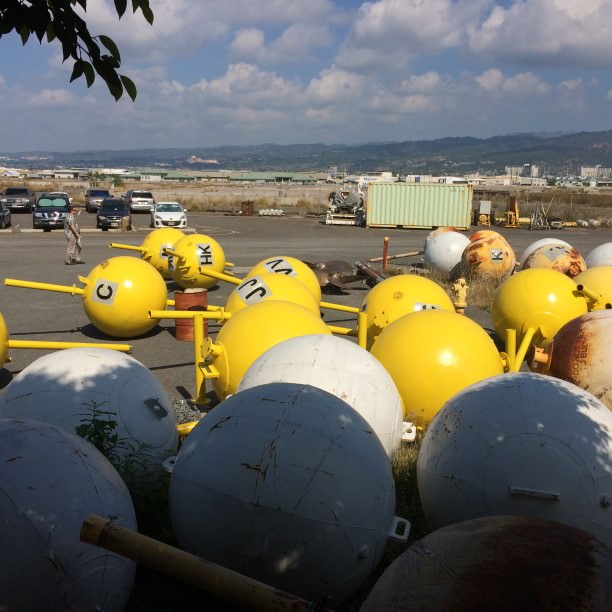
What Are FADs?
FADs are floating devices anchored to the ocean floor and deployed in deep offshore waters. Many pelagic fish naturally congregate around floating objects. FADs use this behavior to create predictable fishing locations offshore without altering nearshore reef habitat.
Hawai‘i’s FAD Program
The State of Hawai‘i FAD program is operated by the Hawai‘i Institute of Marine Biology (HIMB) at the University of Hawai‘i School of Ocean and Earth Science and Technology (SOEST), in collaboration with the Division of Aquatic Resources (DAR).
Key program information:
- Focuses on pelagic fisheries around the Main Hawaiian Islands
- Funded primarily through federal Sport Fish Restoration funds, administered by DAR
- Includes ongoing scientific oversight, monitoring, and maintenance
Hawai‘i was an early adopter of offshore FAD systems designed for deep‑water, high‑energy ocean conditions.
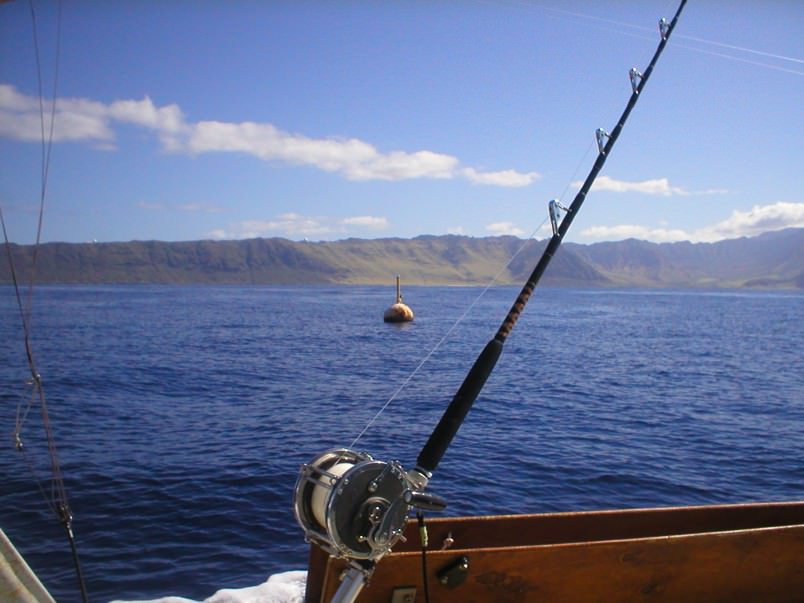
State FADs vs. Drifting dFADs
Not all FADs are the same.
State‑deployed FADs in Hawai‘i:
- Are anchored to the seafloor in deep offshore waters
- Are designed to remain in place, though they may occasionally break free during severe weather
- Are managed and maintained through the State’s FAD program
- Have limited entanglement risk compared to drifting devices
Drifting FADs (dFADs):
- Are not part of Hawai‘i’s FAD program
- Are commonly used in large‑scale purse‑seine fisheries outside of state waters
- May drift long distances when lost or abandoned
- Can become marine debris and navigation hazards if they enter nearshore waters
Private or commercial drifting FADs are not authorized in Hawai‘i state waters.
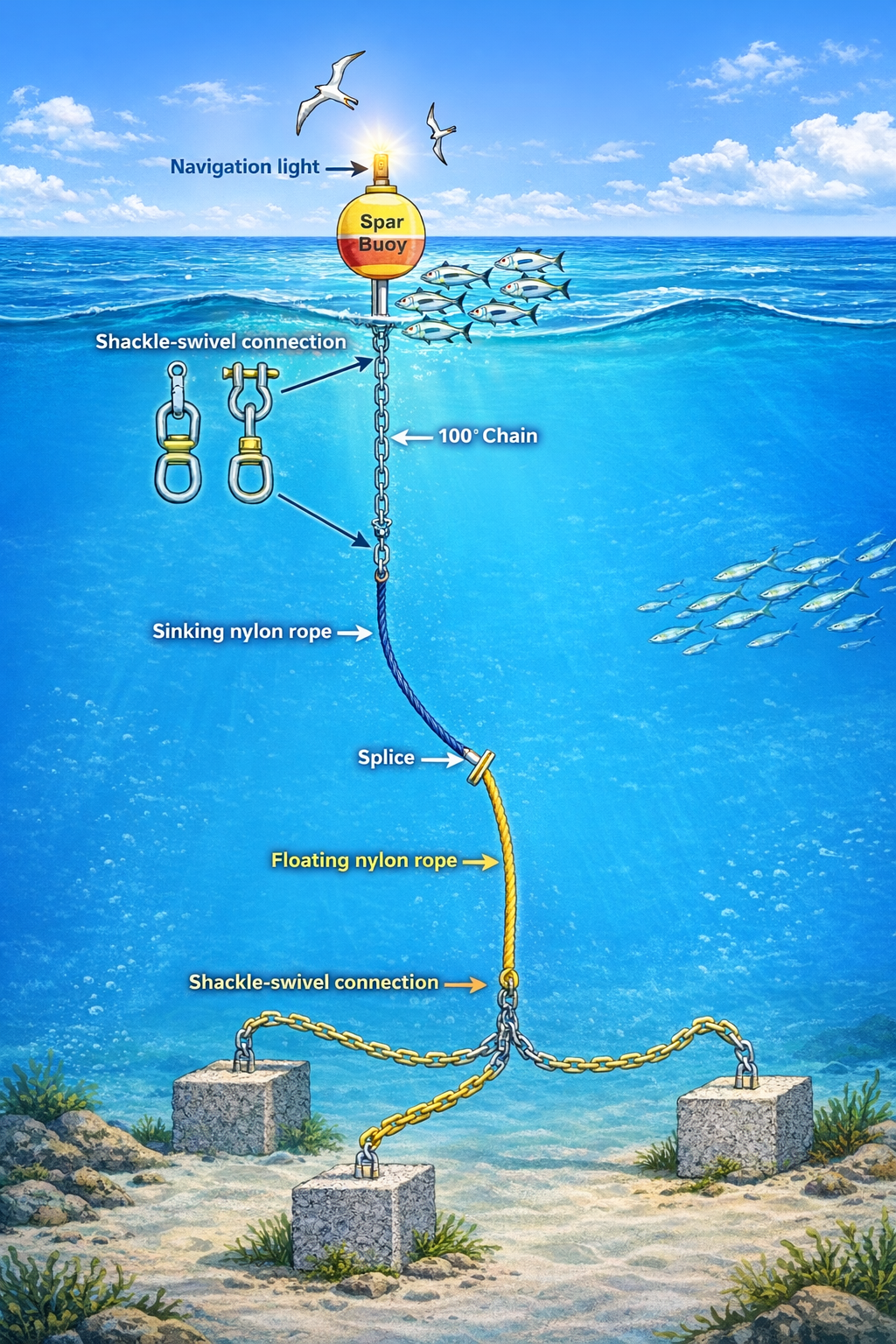
FAD Design and Placement
State FADs are:
- Anchored in deep offshore waters, well away from reefs
- located approximately 2 to 29 miles from shore.
- deployed in depths of 80 to 1500 fathoms, as recommended by Hawaii fishers.
- Designed and monitored to withstand Hawai‘i’s ocean conditions
- FADs are periodically inspected and replaced as part of normal program operations.
FAD Use Regulations
To protect FADs and ensure safe and equitable access, the following activities are prohibited:
- Attaching, mooring, or tying any boat or watercraft to a FAD
- Attaching any rigging, fishing gear, or structure to a FAD
- Boarding, defacing, damaging, removing, or destroying a FAD
Violations may result in enforcement action under Hawai‘i Administrative Rules and state law.
FAD Locations
DAR deploys and maintains FADs statewide around the Main Hawaiian Islands.
View FAD Maps and Coordinates (PDF):
Program Benefits
- Improve access to pelagic fisheries
- Reduce fuel use and search time for fishermen
- Increase fishing efficiency offshore
- Distribute fishing effort away from nearshore reef habitats
- Support sustainable fisheries management
Additional Resources
Contact
Kim Holland
Phone: (808) 220-0112
Email: [email protected]
Warren Cortez
Phone: (808) 956-0684
Email: [email protected]
Karen Gavey
Phone: (808) 428-4813
Email: [email protected]