Learn & Explore/Species/Introduced & Invasive/Kanda Mullet

Kanda Mullet

Category: Invasive

An introduced mullet that spreads quickly in Hawaiʻi’s estuaries, often out-competing native mullet species.

Kanda Mullet (Osteomugil engeli)

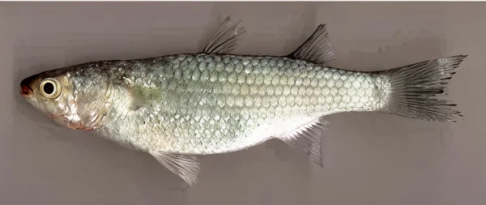
  • A mullet that is silvery in color, turning slightly dusky dorsally. Has a forked caudal fin with a narrow black margin; the dorsal fins are equally high 6

  • Commonly mistaken for undersized ‘ama’ama (Mugil cephalus), a native Hawaiian mullet species 8

  • Adult size ranges from 30 mm to 209 mm (fork length), with females of the species averaging 23 mm larger than the males 8

  • This species also spawns year-round and has a short life span of 7 months 8

  • Generalist herbivore that eats microalgae 8

kanda mullet
Photo courtesy of Michael N. Trevor, from U.S. Geological Survey

Habitat

  • Adults primarily inhabit nearshore marine waters and estuaries and can also be found in brackish water.

  • O. engeli ranges across the Indo‑Pacific, reaching from East Africa to the Marquesas and Tuamotu Islands to the Yaeyama Islands. 1

Impacts & Concern

  • The advantages of year-round spawning and young size at maturity contribute to its success as an invasive species in Hawaiʻi, especially when compared to the native ʻamaʻama, which spawns seasonally and takes 3-4 years to reach sexual maturity 8

  • Because of their similarity to ʻamaʻama, and small size, many fishermen misidentify the species as undersized ʻamaʻama and release their catch back into the water 8

  • Dominant species in hawaiian estuary ecosystems; it even comprised up to 80% of all mullet populations in Kauaʻi during the 1970s 8

  • The kanda mullet and ʻamaʻama share habitat space, even as juveniles, and prefer estuaries with invasive mangroves 2

Introduction

  • Accidentally released in Hawaiʻi 6

  • Individuals were present in a bait fish (Marquesan sardine Sardinella marquesensis) population that was purposefully introduced in the 1950s 6 

Distribution in Hawai’i

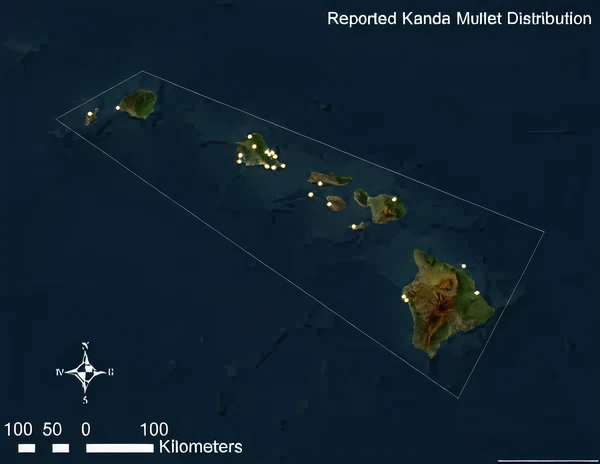
Established throughout the main Hawaiian Islands

  • Kauaʻi: Present in marine waters

  • O‘ahu: Maunalua Bay, Kāne‘ohe Bay

  • Molokaʻi: Present in marine waters

  • Lānaʻi: Present in marine waters

  • Maui: Present in marine waters

  • Hawaiʻi: Hilo Bay

Related AIS Team Management Projects

  • DAR teams have focused on outreach, creating identification cards to teach fishermen and community members how to distinguish between the kanda mullet and native ʻamaʻama and uouoa.

  • The DAR estuarine team has conducted statewide surveys to try and determine the effects interspecific competition has had between the kanda mullet and ‘ama’ama, as well as learn more about the kanda mullet’s life history traits.

Regulations

  • Prohibited for import, not currently listed under HDOA import rules (§4-71-6.5)

References and Further Reading

  1. Froese, R., and Pauly, D. (Editors) (2018) FishBase. World Wide Web electronic publication. www.fishbase.org. Accessed August 27 2024

  2. Goecke, S. D., and Carstenn, S. M. (2017). Fish communities and juvenile habitat associated with non-native Rhizophora mangle L. in Hawai‘i. Hydrobiologia, 803(1), 209–224. https://doi.org/10.1007/s10750-017-3182-7

  3. Maciolek, J.A. 1984. Exotic fishes in Hawaiʻi and other islands of Oceania. Pages 131-161 in Courtenay, W.R., Jr., and J.R. Stauffer, Jr, eds. Distribution, ecology, and management of exotic fishes. John Hopkins University Press. Baltimore, MD.

  4. Mundy, B.C. 2005. Checklist of Fishes of the Hawaiian Archipelago: volume 6 Bishop Museum Bulletins in Zoology, Bishop Museum Press, Honolulu, Hawaiʻi, USA.

  5. Parenti, L.R., D.E. Pitassy, Z. Jaafar, K. Vinnikov, N.E. Redmond, and K.S. Cole. 2020. Fishes collected during the 2017 MarineGEO assessment of Kāne‘ohe Bay, O‘ahu, Hawai‘i. Journal of the Marine Biological Association of the United Kingdom 100(4):607-637. https://doi.org/10.1017/S0025315420000417.

  6. Randall JE (1987) Introductions of marine fishes to the Hawaiian islands. B Mar Sci 41(2):490–502

  7. Randall, J.E. 2003. Reef and shore fishes of the South Pacific: New Caledonia to Tahiti and the Pitcairn Islands. University of Hawaiʻi Press, Honolulu, Hawaiʻi, USA.

  8. Schemmel, E., Kamikawa, K., Shimoda, T., & Peyton, K. A. (2019). The life history of the invasive mullet, Osteomugil engeli (Bleeker, 1858) in Hawaiian estuaries. Environmental Biology of Fishes, 102(4), 553–568. https://doi.org/10.1007/s10641-019-00853-y
Other Introduced & Invasive